Dark Chocolate Mirror Glaze Entremet with Raspberry and Pistachio
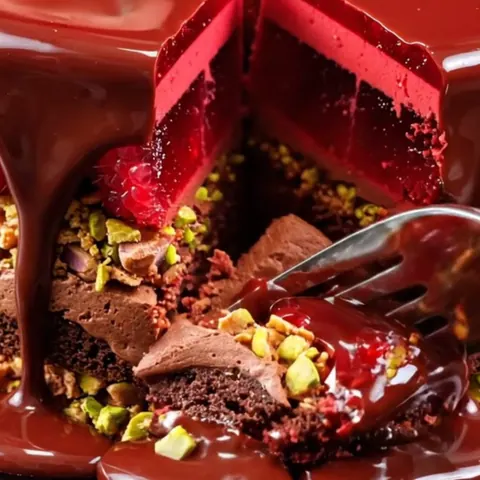
A glossy crimson and black mirror glaze over layers of dark chocolate mousse, tart raspberry gelée and crunchy pistachio feuilletine. Freeze overnight, pour at 92°F and slice clean.
Published 11 min read
- Total time
- Prep
- Cook
- Rest
- Serves
- 12
- Makes one 8-inch entremet
- Cuisine
- French patisserie
- Calories
- 520
- per serving, estimated

On this page16 sections
Watch a glossy crimson and black mirror glaze pour over a chilled mousse entremet and set into a surface like polished glass. Under the shine sit layers of dark chocolate mousse, tart raspberry gelée and crunchy pistachio feuilletine, ready to slice into clean geometric portions.
This entremet is a showpiece built in three stages: a frozen base of raspberry gelée, a dark chocolate mousse layered with pistachio feuilletine, and a cocoa mirror glaze cooled to exactly 92°F and poured in one continuous stream. The method is simple but precise. Each stage needs to be fully set before the next goes on, and the glaze needs the right temperature to coat evenly. Plan the cake the day before serving, because the mousse and gelée need an overnight freeze to hold their shape under the glaze. Once the glaze is poured, the cake needs only a short rest in the refrigerator before it is ready to unmold and slice. The result is a dessert with contrasting textures: silky mousse, bright raspberry, crisp pistachio and a thin, glossy chocolate shell.
The appeal
Why you’ll love it
The gelée goes into the mold first and freezes solid, which gives the entremet a stable base. Freezing the gelée before the mousse prevents the layers from mixing and keeps the raspberry flavour sharp against the rich chocolate. Each layer sets on the one below, so the cake keeps its geometric shape when it is sliced.
The mirror glaze works because of the gelatin and the temperature. Gelatin gives the glaze enough body to hold a smooth, glossy film over a frozen surface. Cooling the glaze to 92°F before pouring keeps it fluid enough to spread evenly yet thick enough to cling to the sides and set without dripping off. A glaze that is too warm runs off the cake, and one that is too cool leaves ridges and dull patches.
What you need
Ingredients
Makes one 8-inch entremet.
Dark chocolate mousse
Raspberry gelée
Pistachio feuilletine
Mirror glaze
Contains:
- Milk
- Eggs
- Gluten
- Tree nuts
Tools
Equipment
- 8-inch springform or entremet ring mold
- Offset spatula
- Stand or hand mixer
- Fine-mesh sieve
- Instant-read thermometer
- Hot knife or thin sharp knife
- Cake board or flat plate
Swaps
Substitutions
Instead ofSeedless raspberry purée
UseStrained raspberry jam, warmed and thinned with a little water
Instead ofCrisp feuilletine flakes
UseCrushed plain shortbread cookies, lightly toasted
Instead ofPistachios
UseToasted hazelnuts, chopped fine
Good to know
Notes
Use a dark chocolate with a clear cocoa flavour for the mousse, and keep the glaze base simple so the cocoa and condensed milk taste clean. Heavy cream must be cold to whip to soft peaks. Bloom the gelatin in cold water so it dissolves evenly in both the gelée and the glaze, and strain the glaze to remove any lumps before pouring.
Use an 8-inch springform or entremet ring mold lined with acetate or plastic wrap so the cake releases cleanly. A flat cake board or plate underneath keeps the base level in the freezer. An instant-read thermometer is essential for the glaze, because the pour window at 92°F is narrow. Crushed feuilletine flakes add crunch, but plain shortbread crumbs work if you cannot find them, and toasted hazelnuts can replace the pistachios.
Prep
Before you start
Gather every ingredient and piece of equipment before you start. Line the ring mold with acetate or plastic wrap and set it on a flat board so the cake freezes level. Bloom the gelatin for the gelée and for the glaze in separate small bowls of cold water and let them soften for about 5 minutes. Chop the dark chocolate finely so it melts evenly, and measure the cocoa, sugar and condensed milk for the glaze. Keep the heavy cream in the refrigerator until you are ready to whip it. Have an instant-read thermometer and a fine-mesh sieve within reach, because the glaze moves quickly from pouring temperature to too cool once it leaves the heat. Clear a level shelf in the freezer for the mold, since it has to stay flat overnight.
Step by step
Method
Phase 1
Build and freeze the base
Step 1: Make the raspberry gelée
Bloom the gelatin in cold water for 5 minutes. Warm the raspberry purée with the sugar over medium heat until steaming, then stir in the softened gelatin until dissolved. Pour into the ring mold over a flat base and freeze until firm.
You’ll need: raspberry purée · granulated sugar · powdered gelatin
Look for: Gelée is clear-red, slightly jiggly at the edges and fully set to the touch after freezing.
Tip: Keep the gelée thin so it spreads evenly across the base of the ring.
Step 2: Build the mousse layers
Melt the dark chocolate gently and let it cool slightly. Whip the cold cream to soft peaks. Whisk the egg yolks with the sugar, fold in the melted chocolate, then fold in the whipped cream and the whipped egg whites. Spread half over the frozen gelée.
You’ll need: dark chocolate, finely chopped · heavy cream · large eggs, separated · granulated sugar
Internal temperature 160°F (71°C)
Look for: Mousse is smooth, thick and holds a soft ribbon on the spatula, with no streaks.
Tip: Fold gently so the mousse keeps its airy, mousse-like texture.
Step 3: Add pistachio feuilletine layer
Mix the chopped pistachios and crushed feuilletine flakes into a thin layer over the mousse. Top with the remaining mousse, level the surface and freeze overnight until fully solid.
You’ll need: pistachios · crushed crisp feuilletine flakes · dark chocolate, finely chopped
Look for: The cake is firm and cold right through, with no give when pressed in the centre.
Tip: Freeze overnight so the cake is solid enough to take the glaze cleanly.
Checkpoint
The raspberry gelée should be clear and fully set, with no soft centre when you touch it. The mousse layers should be smooth and thick, with no streaks of melted chocolate, and the feuilletine layer should sit evenly between them. When you press the top of the mold in the freezer, it should feel completely firm and cold all the way through. Check that the sides are straight and the surface is level before you move on, because any unevenness will show through the glaze. The gelée should not slide when the mold is tilted, and the mousse should hold a clean edge against the lining without tearing it. If anything still gives under light pressure, return the mold to the freezer for another hour before glazing.
Phase 2
Cook and cool the glaze
Step 4: Cook the mirror glaze base
Whisk the cocoa with the sugar, water and condensed milk in a saucepan. Bring to a gentle boil over medium heat, stirring constantly, and cook 1 minute. Remove from heat and whisk in the bloomed gelatin until fully dissolved.
You’ll need: unsweetened cocoa powder · granulated sugar · water · sweetened condensed milk · powdered gelatin
Look for: Glaze is smooth, dark and glossy with no grainy cocoa left on the whisk.
Tip: Whisk constantly so the cocoa does not scorch on the bottom of the pan.
Step 5: Cool the glaze to 92°F
Pass the glaze through a fine-mesh sieve into a clean bowl. Let it cool, stirring now and then, until an instant-read thermometer shows exactly 92°F (33°C). Stir gently to release bubbles before pouring.
You’ll need: unsweetened cocoa powder · granulated sugar
Look for: Glaze reads 92°F (33°C) and flows in a thick, even ribbon off the whisk.
Tip: Check the temperature often; a glaze that is too warm slides off the cake.
Step 6: Pour the glaze over the frozen cake
Place the frozen cake on a rack over a tray. Pour the glaze in one continuous stream from the centre outward, letting it cover the top and run down the sides. Tap the rack lightly to smooth the surface.
You’ll need: unsweetened cocoa powder · granulated sugar
Look for: Glaze coats the top and sides in one smooth sheet with no thin or bare spots.
Tip: Pour in one continuous motion to avoid air bubbles and streaks.
Checkpoint
The cooked glaze should look dark, smooth and glossy, with no grainy cocoa on the whisk or the sides of the pan. It should coat the back of a spoon in a thin layer and fall back in a steady ribbon. Strain it through the fine-mesh sieve to remove any lumps or cooked bits, then let it cool while stirring gently. Watch the thermometer as it drops; you want exactly 92°F (33°C) before pouring. The surface should be free of large bubbles, which you can release by stirring slowly. If the glaze thickens too fast, set the bowl in a larger bowl of warm water and stir. Do not pour until the reading holds steady at 92°F.
Phase 3
Pour, set and slice
Step 7: Set the glaze and unmold
Let the glazed cake sit in the refrigerator for 30 minutes so the glaze sets. Run a warm knife around the ring, lift it away and transfer the entremet to a serving plate.
You’ll need: unsweetened cocoa powder
Look for: Glaze is set glossy and no longer runs when the cake is tilted.
Tip: Use a warm knife to release the ring cleanly without cracking the glaze.
Step 8: Slice and serve
Dip a sharp knife in hot water and wipe it dry between cuts. Slice the entremet into 12 portions, cleaning the blade each time, to reveal the raspberry, mousse and pistachio layers.
You’ll need: raspberry purée · pistachios
Look for: Slices show clean, distinct layers of raspberry, mousse and pistachio crunch.
Tip: A hot, dry blade gives crisp, clean edges on every slice.
Checkpoint
After pouring, the glaze should cover the top and run evenly down every side without thin or bare patches. It should look mirror-smooth and no longer flow once the cake is tilted slightly on the rack. Refrigerate the cake for about 30 minutes so the glaze sets fully before you unmold. When you cut the first slice with a hot, dry knife, the layers should separate cleanly and the pistachio crunch should be audible. Check the cut edge for even layers, and if the knife drags, wipe the blade and warm it again before continuing.
Doneness
How to tell it’s done
The entremet is ready to slice when the glaze is fully set, glossy and no longer tacky to a light touch, which usually takes about 30 minutes in the refrigerator after pouring. The mousse and gelée should be firm enough to hold a clean edge when the slice is lifted. Because this dessert contains eggs in the mousse, the mousse is cooked by the warm chocolate and whipped yolk mixture, and it should be cooked through to 160°F (71°C) before folding in the whites. Once sliced, the layers should look distinct, with the raspberry bright and the pistachio crisp.
Avoid these
Common mistakes
The most common problem is pouring the glaze at the wrong temperature. Above 92°F it slides off the sides and leaves the top thin; below it, the glaze thickens unevenly and shows ridges or dull patches. Avoid this by checking with the thermometer and stirring the glaze gently to release air. Another mistake is pouring onto a cake that is not frozen solid. A soft mousse surface softens the glaze and leaves marks, so give the cake the full overnight freeze. Whisking the glaze too hard after cooking also introduces bubbles that show as tiny pits in the finished shine. Finally, do not cut the entremet with a cold blade, which can crack the glaze and drag the layers.
Cook safely
Food safety
Safe internal temperatures
Cook to at least these temperatures, measured with an instant-read thermometer in the thickest part.
| Food | Minimum internal temperature |
|---|---|
| Egg dishes | 160°F (71°C) |
Better results
Tips
Tip 1
Keep the glaze moving slowly while it cools, and never let it reach a full boil again. Stirring at a steady pace releases trapped air and helps the glaze keep its even sheen.
Tip 2
Set the mold on a level surface before freezing. A tilted cake gives a sloping glaze, and a level base gives the glossy, geometric finish this recipe is built around.
Make it yours
Variations
Raspberry jam base
Replace the raspberry purée with warmed seedless raspberry jam thinned with a spoon of water. The gelée sets a little firmer and the flavour is sweeter and more concentrated.
Hazelnut crunch
Swap the pistachios for toasted hazelnuts and the feuilletine for crushed shortbread. The layer becomes toastier, with a buttery bite that pairs well with the dark chocolate.
Milk chocolate mousse
Use milk chocolate in place of the dark chocolate for a softer, sweeter mousse. Keep the glaze unchanged so the mirror finish stays the same.
Individual glazed cups
Pour the layers into small silicone moulds instead of one ring mold. Freeze, then glaze each cup at 92°F for single servings with the same glossy finish.
On the table
Serving suggestions
Bring the entremet to the table straight from the refrigerator and slice it with a hot, dry knife, wiping the blade between cuts. Serve each slice on a small plate with a spoon of raspberry juice around the edge if you have some left over. A chilled glass of sparkling water or a cup of strong black coffee suits the dark chocolate well. The contrast between the cold mousse and the crisp pistachio layer is best enjoyed within the first hour after slicing.
For a more formal dessert, present the whole cake on a long platter so guests can see the geometric layers before you cut. Garnish with a few fresh raspberries and a light scatter of chopped pistachios, keeping the garnish minimal so the glaze remains the focus. Serve small portions, since the entremet is rich. Leftover slices can be returned to the refrigerator covered in clean plastic wrap.
Leftovers
Storage & make-ahead
- Fridge
- Store slices covered in an airtight container for up to three days, chilled and kept away from strong-smelling foods.
- Freezer
- Freezing is not recommended once glazed, because the mirror finish can craze and the feuilletine loses its crunch.
- Reheat
- No reheating is needed; serve the entremet cold, straight from the refrigerator.
Keep the glazed entremet in the refrigerator, covered loosely so the glaze stays clean and does not pick up odours. Place it on a flat plate or board and leave the acetate on the sides until serving if you want to protect the shine. Slices keep well for up to three days when stored in an airtight container. Handle the cake gently, since the glaze chips if it is knocked. Serve it chilled so the mousse keeps its structure and the feuilletine stays crisp.
Make ahead
This entremet is designed to be made a day ahead. Make the gelée and the mousse layers, freeze the cake overnight, then glaze it the next morning or the evening before serving. The glaze can be cooked up to a day in advance and kept covered in the refrigerator; warm it gently to about 100°F, then cool it back to 92°F before pouring. Do not glaze the cake too early, because the mirror shine is best on the day it is set.
Questions
Frequently asked questions
Can the mirror glaze be made a day ahead?
Yes. Cook the glaze, strain it and refrigerate it covered. Before pouring, warm it gently to about 100°F, stirring slowly to avoid bubbles, then cool it back down to 92°F (33°C) and check the temperature with an instant-read thermometer. Pouring it at the correct temperature matters more than the time it was made.
Why does the glaze slide off the cake?
The glaze is usually too warm or the cake is not frozen solid. Above 92°F the glaze runs off the sides and thins on top. Freeze the cake overnight so the surface is firm, and check the glaze temperature right before pouring.
What if you do not have an entremet ring mold?
A springform pan works well. Line the sides with acetate or plastic wrap, and keep the layers level on a flat board in the freezer. The cake will be slightly shorter in a wider pan, but the glaze method stays the same.
Why does the mousse contain eggs and how is it cooked?
The egg yolks are whisked with sugar and folded into warm melted chocolate, which thickens the mousse and gives it body. The mixture should reach 160°F (71°C) to be cooked through before the whipped cream and egg whites are folded in. Use pasteurised eggs if you are serving pregnant women, young children, older adults or anyone with a weakened immune system.
Can you freeze the finished entremet?
Freezing is not recommended once the cake is glazed, because the shine can craze and the feuilletine loses its crunch. Freeze the unglazed cake overnight as the recipe describes, then glaze it fresh and keep the finished dessert refrigerated for up to three days.
Everything in one place: the recipe card below gathers the ingredients, steps and estimated nutrition, ready to print.
Recipe card
Dark Chocolate Mirror Glaze Entremet with Raspberry and Pistachio
A glossy crimson and black mirror glaze over layers of dark chocolate mousse, tart raspberry gelée and crunchy pistachio feuilletine. Freeze overnight, pour at 92°F and slice clean.
- Prep
- Cook
- Rest
- Total
- Servings
- one 8-inch entremet
Ingredients
Dark chocolate mousse
- 6 oz dark chocolate, finely chopped
- 1 1/2 cups heavy cream, cold
- 3 large eggs, separated
- 2 tbsp granulated sugar
Raspberry gelée
- 1 cup seedless raspberry purée
- 2 tbsp granulated sugar
- 1 tsp powdered gelatin, bloomed in 1 tbsp cold water
Pistachio feuilletine
- 1/2 cup finely chopped pistachios
- 1/2 cup crushed crisp feuilletine flakes
Mirror glaze
- 1/3 cup unsweetened cocoa powder
- 1 cup granulated sugar
- 1/2 cup water
- 3/4 cup sweetened condensed milk
- 1 tbsp powdered gelatin, bloomed in 3 tbsp cold water
Instructions
Make the raspberry gelée. Bloom the gelatin in cold water for 5 minutes. Warm the raspberry purée with the sugar over medium heat until steaming, then stir in the softened gelatin until dissolved. Pour into the ring mold over a flat base and freeze until firm.
Build the mousse layers. Melt the dark chocolate gently and let it cool slightly. Whip the cold cream to soft peaks. Whisk the egg yolks with the sugar, fold in the melted chocolate, then fold in the whipped cream and the whipped egg whites. Spread half over the frozen gelée.
Add pistachio feuilletine layer. Mix the chopped pistachios and crushed feuilletine flakes into a thin layer over the mousse. Top with the remaining mousse, level the surface and freeze overnight until fully solid.
Cook the mirror glaze base. Whisk the cocoa with the sugar, water and condensed milk in a saucepan. Bring to a gentle boil over medium heat, stirring constantly, and cook 1 minute. Remove from heat and whisk in the bloomed gelatin until fully dissolved.
Cool the glaze to 92°F. Pass the glaze through a fine-mesh sieve into a clean bowl. Let it cool, stirring now and then, until an instant-read thermometer shows exactly 92°F (33°C). Stir gently to release bubbles before pouring.
Pour the glaze over the frozen cake. Place the frozen cake on a rack over a tray. Pour the glaze in one continuous stream from the centre outward, letting it cover the top and run down the sides. Tap the rack lightly to smooth the surface.
Set the glaze and unmold. Let the glazed cake sit in the refrigerator for 30 minutes so the glaze sets. Run a warm knife around the ring, lift it away and transfer the entremet to a serving plate.
Slice and serve. Dip a sharp knife in hot water and wipe it dry between cuts. Slice the entremet into 12 portions, cleaning the blade each time, to reveal the raspberry, mousse and pistachio layers.
Allergens: Milk, Eggs, Gluten, Tree nuts
Nutrition (estimated, per serving)
- Calories
- 520 kcal
- Protein
- 7.5 g
- Carbs
- 52 g
- Fat
- 32 g
- Fiber
- 3 g
- Sugar
- 44 g
- Sodium
- 95 mg
Estimates only: values vary with brands, substitutions and portion sizes.
Recipe by EasyCooks Kitchen · easycooksrecipes.com
Share this recipe
Send it to someone who’d love it, or save it for later.
Spotted a mistake in this recipe? Let us know.
Keep cooking


