Jammy Soy-Marinated Eggs on Whipped Ricotta Toast
Six-minute jammy eggs marinated overnight in soy, mirin and garlic, served over whipped ricotta sourdough. A make-ahead savory breakfast with a custardy amber yolk and deep umami flavor.
Published 12 min read
- Total time
- Prep
- Cook
- Rest
- Serves
- 4
- Makes 4 jammy eggs, 4 toasts
- Cuisine
- Japanese-inspired
- Calories
- 320
- per serving, estimated

On this page16 sections
Six-minute jammy eggs, soaked overnight in dark soy, mirin and garlic, turn a deep mahogany and reveal a custardy amber yolk. Spread over whipped ricotta on sourdough, they make a savory breakfast you can prepare the day before and plate in minutes, with sesame and scallion adding crunch and freshness to every bite.
This recipe builds a make-ahead breakfast around one simple idea: a soft-cooked egg that is then marinated until it takes on the flavor of the sauce. The marinade is a balanced mix of dark soy sauce, mirin and water, sweetened lightly with brown sugar and perfumed with smashed garlic and a single star anise. You boil four large eggs for exactly six minutes and thirty seconds, shock them in ice water, peel them and then leave them to marinate for twelve hours in the refrigerator. The result is a jammy yolk, a mahogany white and a deep umami flavor that stands up to the cool, creamy whipped ricotta and the crisp toasted sourdough. Once the eggs are marinated, the final assembly takes only a few minutes, which is why this dish works so well as an early-morning or weekend prep.
The appeal
Why you’ll love it
The timing does the work. Boiling for exactly six minutes and thirty seconds sets the whites while the center stays thick and jammy. Shocking the eggs in ice water stops the cooking immediately and makes the shells easier to remove without tearing the whites. Because the eggs are already cooked, the marinade only needs to season and color them, not cook them, so the yolk keeps its soft, custardy texture.
The overnight soak builds the flavor. Soy sauce carries salt and savory depth, mirin adds gentle sweetness and a glossy finish, and the garlic and star anise add aromatic warmth. Over twelve hours these ingredients penetrate the whites and turn them a rich brown, while the yolk absorbs just enough seasoning to taste savory without losing its custard. The cool, fresh ricotta then balances the saltiness of the egg, which is why the two pair so naturally on toast.
What you need
Ingredients
Makes 4 jammy eggs, 4 toasts.
Eggs
Marinade
Toast
Garnish
Contains:
- Eggs
- Soy
- Gluten
- Milk
- Sesame
- Sulfites
Served raw or lightly cooked
The eggs are not cooked through, so the yolks stay soft and jammy. Pregnant women, young children, older adults and anyone with a weakened immune system should use pasteurised eggs.
Tools
Equipment
- Medium saucepan
- Slotted spoon
- Large bowl for ice bath
- Small saucepan or measuring cup
- Shallow dish or zip-top bag for marinating
- Fine-mesh sieve
- Small bowl and whisk or spatula
Swaps
Substitutions
Instead ofDark soy sauce
UseRegular soy sauce, slightly less saltiness and lighter color
Instead ofBrown sugar
UseGranulated sugar, for a cleaner sweetness
Instead ofSourdough bread
UseCountry-style bread or rye, toasted until crisp
Good to know
Notes
Choose large eggs as close to room temperature as possible so the six-minute and thirty-second timing gives a consistent yolk. Dark soy sauce gives the marinade its deep color and a slightly sweeter, rounder flavor than regular soy sauce, though regular soy sauce works in a pinch. Mirin is a sweet Japanese rice cooking wine, so it is sold in the Asian aisle of many supermarkets and contains sulphites. Brown sugar is measured in grams in the video, so use a kitchen scale if you have one; a level tablespoon of packed brown sugar is a close equivalent.
You need a medium saucepan, a slotted spoon, a large bowl for the ice bath, a small saucepan for the marinade, a shallow dish or a zip-top bag for the eggs, and a small bowl with a spatula or whisk for the ricotta. A fine-mesh sieve is helpful if you want the ricotta extra smooth. Whole-milk ricotta gives the best whipped texture; part-skim ricotta works but tastes thinner. For a shortcut, you can use granulated sugar in place of brown sugar, and rye or country-style bread can replace sourdough.
Prep
Before you start
Gather all the equipment before you start, and set out an ice bath in a large bowl with plenty of ice and cold water. Measure the soy sauce, mirin, water and brown sugar into a small saucepan, and have the smashed garlic cloves and the single star anise ready beside the stove. Check that the eggs are large and fresh, and keep a timer within reach, because the six-minute and thirty-second boil depends on exact timing. Plan the marinade ahead of time: the eggs must sit in the cooled liquid for twelve hours, so start this recipe the day before you plan to serve it. Set the ricotta out to soften slightly, and have the sourdough, toasted sesame seeds and scallions prepared so assembly moves quickly once the eggs are ready.
Step by step
Method
Phase 1
Simmer and cool the marinade
Step 1: Simmer the marinade
Combine 60 ml dark soy sauce, 60 ml mirin, 60 ml water, 10 g brown sugar, the smashed garlic cloves and the star anise in a small saucepan. Bring to a gentle simmer over medium heat, stir until the sugar dissolves, then remove from the heat and let it cool completely.
You’ll need: dark soy sauce · mirin · water · brown sugar · garlic, smashed · star anise
Look for: Sugar fully dissolved, liquid smells sweet and savory with anise, no sugar crystals on the spoon.
Tip: Cool the marinade fully before adding eggs, or the shells will crack and the eggs will cook further.
Step 2: Boil the eggs
Bring a medium saucepan of water to a rolling boil at 212°F (100°C). Lower the 4 large eggs in with a slotted spoon and boil for exactly 6 minutes and 30 seconds, keeping the water at a steady boil.
You’ll need: eggs
Internal temperature 160°F (71°C)
Look for: Water is at a steady rolling boil and the eggs are moving freely on the bottom of the pan.
Tip: Set a timer as soon as the eggs go in, since a 30-second difference changes the yolk.
Checkpoint
The marinade should look dark, glossy and fragrant, with the sugar fully dissolved and no crystals clinging to the spoon. The garlic and star anise should have released a gentle, sweet and savory aroma. Before you go on, make sure the liquid has cooled completely to room temperature, because hot marinade will crack the shells and cook the eggs further, and you want the boiled eggs to stay jammy inside. Pour a small test spoon onto a cool plate; if it feels only faintly warm, the marinade is ready for the eggs.
Phase 2
Boil, chill and peel the eggs
Step 3: Shock and peel
Transfer the eggs to a large bowl of ice water and chill for at least 5 minutes until cold to the touch. Tap each shell gently all over, then peel under cool running water, starting at the wider end.
You’ll need: eggs
Look for: Eggs feel cold to the touch, and the shells slip off in large pieces.
Tip: Peel under running water to help lift the membrane away from the white.
Step 4: Marinate the eggs
Place the peeled eggs in a shallow dish or zip-top bag and pour the cooled marinade over them so they are fully submerged. Cover and refrigerate for 12 hours so the whites take on color and the yolks turn jammy.
You’ll need: eggs · dark soy sauce · mirin · water · brown sugar · garlic, smashed · star anise
Look for: Whites are deep mahogany after 12 hours and the eggs are fully covered by the liquid.
Tip: Turn the eggs once or twice during the marinating time so the color is even.
Checkpoint
After boiling for exactly six minutes and thirty seconds and plunging the eggs into ice water, the whites should be firm and opaque, and the yolks should look soft and deep yellow when you check one with a spoon. Once the eggs are cold, tap and peel them gently under cool running water so the whites stay smooth and unbroken. The shells should slip off in large pieces, leaving clean, pale ovals. Check each peeled egg for cracks or torn whites before placing it in the marinade, because damaged whites can absorb too much soy and turn unevenly dark.
Phase 3
Marinate, toast and assemble
Step 5: Toast the sourdough
Toast the sourdough slices until golden and crisp, then season the ricotta with a small pinch of kosher salt and whip it in a small bowl until light and spreadable. Spread a generous layer over each toast.
You’ll need: sourdough bread · whole-milk ricotta cheese · kosher salt
Look for: Toast is golden and crisp at the edges, ricotta looks light and fluffy when whipped.
Tip: Whip ricotta with a spatula for a few seconds to loosen its texture.
Step 6: Halve and garnish
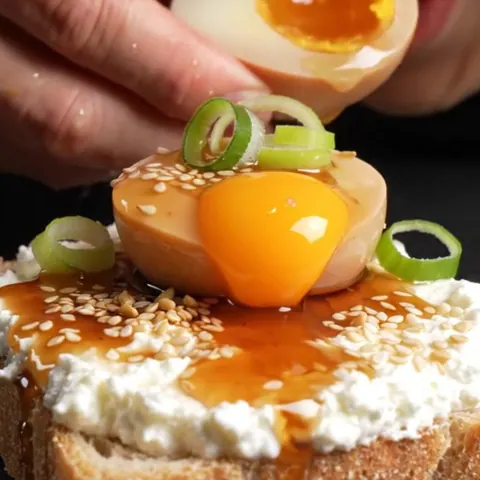
Lift each marinated egg from the marinade, drain briefly and cut in half lengthwise. Place two halves on each ricotta toast, sprinkle with toasted sesame seeds, and top with scallion curls before serving.
You’ll need: eggs · whole-milk ricotta cheese · sourdough bread · toasted sesame seeds · scallions, cut into curls
Look for: Yolks look glossy and amber in the center, with dark mahogany whites and bright green scallion curls on top.
Tip: Use a sharp knife, wiped between cuts, for clean halves with the yolk visible.
Checkpoint
After twelve hours in the refrigerator the whites should have turned a deep, even mahogany and the yolks should look amber and jammy when you halve one. Toast the sourdough until it is golden and crisp at the edges, and whip the ricotta until it is light, smooth and spreadable. When you cut each egg, the center should look glossy and custardy, not chalky. Spread the ricotta generously on the toast, add two egg halves, and finish with sesame seeds and scallion curls, then serve while the toast is still crisp.
Doneness
How to tell it’s done
The eggs are ready when the whites are firmly set and deep mahogany all the way through, and the yolks are glossy, amber and jammy, with a soft, custardy center that holds its shape when halved. A properly jammy yolk is thick and spreadable, not chalky and not runny. Because the eggs are served soft, they are not cooked through to the 160°F (71°C) safe temperature that applies to fully set eggs; if you want fully set yolks, boil the eggs for about nine minutes instead. Check one egg before serving by cutting it in half, and if the yolk is still too loose or too firm for your taste, adjust the boiling time next time by a few seconds.
Avoid these
Common mistakes
The most common mistake is boiling the eggs for too long or too short a time, since thirty seconds in either direction changes the yolk from jammy to fully set or to runny. Use a timer and keep the water at a steady rolling boil. Another frequent problem is marinating warm liquid: it cracks the shells and can cook the eggs further, so cool the marinade fully first. Do not skip the ice bath, because it stops the cooking and makes peeling easier. Many cooks also peel the eggs too roughly, which tears the whites and lets the marinade soak in unevenly. Finally, avoid marinating for much less than twelve hours, since the whites stay pale and the flavor remains thin; a longer soak makes the eggs richer, but a day or two in the refrigerator is the practical limit.
Cook safely
Food safety
Safe internal temperatures
Cook to at least these temperatures, measured with an instant-read thermometer in the thickest part.
| Food | Minimum internal temperature |
|---|---|
| Egg dishes | 160°F (71°C) |
Raw or lightly cooked ingredients
The eggs are not cooked through, so the yolks stay soft and jammy. Pregnant women, young children, older adults and anyone with a weakened immune system should use pasteurised eggs.
Better results
Tips
Tip 1
Keep the eggs fully submerged in the marinade during the overnight soak. A small plate or a folded piece of parchment on top helps hold them under the liquid. Turn the eggs once or twice so the color is even on all sides.
Tip 2
Set aside a few tablespoons of the cooled marinade after the eggs are removed. It makes a flavorful dip for toast or a splash over steamed rice, but discard any marinade that has held raw egg in a way that cannot be cleaned. Always wash hands and surfaces after handling raw egg shells and liquid.
Make it yours
Variations
Spicy Chili Marinade
Add one or two dried red chilies or a half teaspoon of chili flakes to the marinade while it simmers. Remove the chilies before cooling so the heat stays balanced and the eggs take on a gentle warmth without overpowering the savory flavor.
Ginger and Scallion
Add several thin slices of fresh ginger to the marinade and finish the toast with extra scallion. The ginger brightens the savory base and pairs especially well with the cool, creamy ricotta on the crisp bread.
Rice Bowl Style
Serve the halved marinated eggs over warm steamed rice with sliced cucumber and a spoonful of the cooled marinade. This turns the same eggs into a quick, filling bowl with a clean, savory finish.
Herb Ricotta Toast
Stir chopped fresh chives or a little finely grated lemon zest into the whipped ricotta before spreading it on the toast. The herbs and citrus lighten the rich marinated egg and add a fresh contrast.
On the table
Serving suggestions
Serve the halved eggs on whipped ricotta toast right away, while the sourdough is still crisp and the ricotta is cool. Arrange two egg halves on each slice, with the amber yolks facing up so they catch the light. Finish with a pinch of toasted sesame seeds and a generous handful of scallion curls, then add a pinch of flaky salt if you like. The contrast of cool, creamy ricotta, crisp toast and glossy egg makes this a satisfying breakfast on its own.
For a larger breakfast or a light lunch, pair the toast with a simple green salad dressed with lemon and olive oil, or with a bowl of plain steamed rice and a few slices of cucumber. The salty, sweet umami of the eggs also works beautifully with a hot cup of tea or a cold glass of milk. Keep the presentation simple and let the glossy yolks be the focus of the table.
Leftovers
Storage & make-ahead
- Fridge
- Store marinated eggs in their marinade, covered, in the refrigerator for up to three days.
- Reheat
- No reheating is needed. Serve the marinated eggs cold or at room temperature, and toast fresh bread just before assembling.
Store the marinated eggs in their marinade in a covered container in the refrigerator. They keep well for up to three days, and the color deepens and the flavor becomes richer each day. Keep the whipped ricotta separately in a sealed container and use it within two days. Store the toasted sourdough at room temperature in a bread bag, and keep the scallion curls and sesame seeds in separate small containers so they stay crisp. Refrigerate any leftover assembled toast promptly and eat it the same day, because the toast softens as it sits.
Make ahead
Almost everything in this recipe can be prepared in advance. Make the marinade and let it cool, then boil, chill, peel and marinate the eggs up to two days before you plan to serve. Whip the ricotta the morning of or the night before and keep it refrigerated. Toast the bread just before serving so it stays crisp, and cut the scallions into curls shortly before plating. This split between advance prep and last-minute assembly means a weekend breakfast takes only a few minutes on the day, with no cooking more complicated than toasting bread.
Questions
Frequently asked questions
How long should the eggs boil for a jammy yolk?
Boil the large eggs for exactly six minutes and thirty seconds at a steady rolling boil, then transfer them straight to an ice bath. This timing gives a set white and a soft, custardy yolk that stays spreadable after marinating. Shorter boiling leaves the yolk too loose to hold its shape, while a longer boil firms it up completely. Use a timer and keep the water at a full boil the whole time for consistent results across all four eggs.
Can the marinade be reused for another batch?
The marinade can be reused once for a second batch of eggs if it has been kept refrigerated and was not contaminated by hands or utensils. Strain out the garlic and star anise before storing it, and taste it first, since the flavor will be milder. Refrigerate the reused marinade and use it within a few days. Discard it if it smells sour or looks cloudy, and never reuse marinade that has been left at room temperature.
Why do the eggs need to marinate for twelve hours?
Twelve hours in the refrigerator gives the soy sauce time to color the whites a deep mahogany and to season them evenly throughout. Shorter marinating leaves the whites pale and the flavor thin, while the yolks stay mostly unchanged. Longer soaking deepens the color and makes the eggs saltier, so a full day is the practical limit. Keep the eggs covered and refrigerated for the whole time for food safety.
Can this be made with regular soy sauce instead of dark soy sauce?
Regular soy sauce works, although the marinade will be lighter in color and a little saltier and less rounded in flavor. Dark soy sauce is thicker and slightly sweeter, which gives the eggs their signature mahogany shade. If you use regular soy sauce, you may want to reduce the amount slightly or add a touch more brown sugar to balance the salt. The eggs will still taste savory and pleasant on the toast.
Are the eggs safe to eat if the yolks are still soft?
The jammy yolks are served soft, so they are not cooked through to the 160°F (71°C) safe temperature for fully set eggs. Use pasteurised eggs if you are pregnant, serving young children, cooking for older adults or cooking for anyone with a weakened immune system. Keep the eggs refrigerated throughout marinating and storage. If you prefer fully set yolks, boil the eggs for about nine minutes before marinating instead.
Everything in one place: the recipe card below gathers the ingredients, steps and estimated nutrition, ready to print.
Recipe card
Jammy Soy-Marinated Eggs on Whipped Ricotta Toast
Six-minute jammy eggs marinated overnight in soy, mirin and garlic, served over whipped ricotta sourdough. A make-ahead savory breakfast with a custardy amber yolk and deep umami flavor.
- Prep
- Cook
- Rest
- Total
- Servings
- 4 jammy eggs, 4 toasts
Ingredients
Eggs
- 4 large eggs
Marinade
- 60 ml (1/4 cup) dark soy sauce
- 60 ml (1/4 cup) mirin
- 60 ml (1/4 cup) water
- 10 g (about 1 tbsp packed) brown sugar
- 2 cloves garlic, smashed
- 1 star anise
Toast
- 1/2 cup whole-milk ricotta cheese
- 4 slices sourdough bread
- kosher salt to taste
Garnish
- 1 tsp toasted sesame seeds
- 2 scallions, cut into curls
Instructions
Simmer the marinade. Combine 60 ml dark soy sauce, 60 ml mirin, 60 ml water, 10 g brown sugar, the smashed garlic cloves and the star anise in a small saucepan. Bring to a gentle simmer over medium heat, stir until the sugar dissolves, then remove from the heat and let it cool completely.
Boil the eggs. Bring a medium saucepan of water to a rolling boil at 212°F (100°C). Lower the 4 large eggs in with a slotted spoon and boil for exactly 6 minutes and 30 seconds, keeping the water at a steady boil.
Shock and peel. Transfer the eggs to a large bowl of ice water and chill for at least 5 minutes until cold to the touch. Tap each shell gently all over, then peel under cool running water, starting at the wider end.
Marinate the eggs. Place the peeled eggs in a shallow dish or zip-top bag and pour the cooled marinade over them so they are fully submerged. Cover and refrigerate for 12 hours so the whites take on color and the yolks turn jammy.
Toast the sourdough. Toast the sourdough slices until golden and crisp, then season the ricotta with a small pinch of kosher salt and whip it in a small bowl until light and spreadable. Spread a generous layer over each toast.
Halve and garnish. Lift each marinated egg from the marinade, drain briefly and cut in half lengthwise. Place two halves on each ricotta toast, sprinkle with toasted sesame seeds, and top with scallion curls before serving.
Allergens: Eggs, Soy, Gluten, Milk, Sesame, Sulfites
Nutrition (estimated, per serving)
- Calories
- 320 kcal
- Protein
- 16 g
- Carbs
- 24 g
- Fat
- 17 g
- Fiber
- 1 g
- Sugar
- 5 g
- Sodium
- 980 mg
Estimates only: values vary with brands, substitutions and portion sizes.
Recipe by EasyCooks Kitchen · easycooksrecipes.com
Share this recipe
Send it to someone who’d love it, or save it for later.
Spotted a mistake in this recipe? Let us know.
Keep cooking
More breakfast recipes
Breakfast
Eggnog French Toast Bake with Cinnamon Crumble for an Easy Make-Ahead Brunch
Total time: 1 hr 15 mins
Breakfast
Loaded Tater Tot Breakfast Casserole with Sausage, Eggs and Pepper Gravy
Total time: 1 hr 20 mins