Tropical Crockpot Mango Coconut Macadamia Dump Cake
A dump-and-go slow cooker dessert with ripe mango, coconut cake mix, shredded coconut and macadamia nuts that toast into a golden crust over jammy fruit. Serve warm with coconut ice cream.
Published 13 min read
- Total time
- Prep
- Cook
- Rest
- Serves
- 8
- Makes one 6-quart slow cooker dump cake
- Cuisine
- Tropical American
- Calories
- 520
- per serving, estimated

On this page15 sections
This tropical slow cooker dessert needs no mixing bowl and almost no skill. Ripe mango, coconut cake mix, shredded coconut and macadamia nuts go straight into the ceramic pot, and a pour of melted butter brings everything together. Two and a half hours on high later, the top is golden and crisp while the fruit below turns jammy and sweet, ready for a scoop of cold coconut ice cream.
This Crockpot mango coconut macadamia dump cake is built on one simple idea: layer everything in the slow cooker and let heat do the work. You start with five cups of diced ripe mango spread across the base, then add a dry coconut cake mix, a cup of shredded sweetened coconut and roughly three-quarters of a cup of roasted macadamia nuts. A stick of melted butter poured over the top moistens the dry layers so they can bake into a crust. Once it is on high, the mango releases its juices into a thick syrup, and the coconut and nuts toast on the surface. The result tastes like a warm tropical crumble, but the only real work is peeling and dicing the fruit.
The appeal
Why you’ll love it
The dump-cake method works because the layers do different jobs. The mango sits at the bottom where the slow cooker's gentle, steady heat turns its sugars into a thick, glossy syrup. The dry coconut cake mix and the butter sit above it, so the flour and fat form a tender, crumbly layer rather than a wet batter. Nothing is stirred, which keeps the fruit and the topping separate, so each spoonful gives you both a soft pocket of fruit and a golden, slightly chewy crust.
The two and a half hour cooking time on high is long enough for the coconut flakes and macadamia nuts to toast. Coconut browns quickly once it is exposed to heat, and the nuts release their oil and roast in the same environment. Because the lid stays closed, the moisture from the mango keeps the cake portion from drying out, so the top turns golden without becoming dry or hard. This is why the cake stays tender while the nuts still have a crisp edge.
What you need
Ingredients
Makes one 6-quart slow cooker dump cake.
To serve
Contains:
- Gluten
- Eggs
- Milk
- Tree nuts
- Sulfites
Tools
Equipment
- 6-quart slow cooker with glass lid
- Cutting board and sharp knife
- Mixing spoon
- Serving spoon
- Coconut shell or heatproof bowls
Swaps
Substitutions
Instead ofChampagne mangoes
UseAny ripe mango, about 4 medium mangoes, peeled and diced
Instead ofRoasted macadamia nuts
UseRaw macadamia nuts toasted in a dry skillet for 3 to 4 minutes
Instead ofCoconut cake mix
UseYellow cake mix with 1/2 teaspoon coconut extract added to the dry mix
Good to know
Notes
Ripe champagne mangoes are the best choice for this dessert. They are smaller and sweeter than the common large mango, and their flesh holds its shape while softening into syrup. If you can only find larger mangoes, use about four medium fruits instead of five cups. Choose fruit that is fragrant at the stem and gives slightly when pressed, and avoid fruit that is hard or stringy because it will not break down as well. Frozen mango cubes can be used in a pinch, but thaw and drain them first so the topping does not become watery.
This recipe needs a 6-quart slow cooker with a glass lid, which lets you check the color of the crust without lifting the lid and losing heat. The ceramic insert should be a single, even layer of fruit with the topping evenly spread. For the nuts, choose roasted macadamia nuts that are unsalted if possible, since the cake mix already contains salt. If the nuts are raw, toast them in a dry skillet for three to four minutes until fragrant before chopping. Butter should be fully melted but not hot, so it soaks into the dry mix evenly.
Prep
Before you start
Start by setting out all the ingredients so the layering goes quickly and the fruit does not sit at room temperature for long. Peel the mangoes, cut the flesh away from the pit, and dice it into bite-size cubes of about half an inch. Measure five cups of diced mango and keep it chilled until it goes into the pot. Measure the dry coconut cake mix, the shredded sweetened coconut and the macadamia nuts. If the nuts are raw, toast them in a dry skillet over medium heat for three to four minutes until fragrant, then let them cool and chop them coarsely. Melt the stick of butter in a small bowl in the microwave or on the stove, and let it cool slightly so it does not cook the dry mix when poured.
Step by step
Method
Phase 1
Layer the mango and toppings
Step 1: Prepare the mango
Peel the mangoes and cut the flesh away from the pit. Dice it into bite-size cubes, about 1/2 inch, and spread them evenly across the bottom of the slow cooker insert.
You’ll need: ripe champagne mangoes, peeled and diced
Look for: Cubes are even in size and the bottom of the insert is covered in a single layer of bright orange fruit.
Tip: Ripe mangoes give slightly when pressed and smell sweet at the stem end, which makes them easier to peel and gives a jammier result.
Step 2: Layer the dry topping
Sprinkle the dry coconut cake mix evenly over the mango. Scatter the shredded sweetened coconut over the cake mix, then add the chopped macadamia nuts in an even layer.
You’ll need: ripe champagne mangoes, peeled and diced · coconut cake mix, dry · shredded sweetened coconut · roasted macadamia nuts, chopped
Look for: The cake mix is dry and fully covers the fruit, with coconut and nuts sitting on top.
Tip: Do not stir the layers together. The dry topping should sit on the fruit so it toasts on top while the mango cooks underneath.
Step 3: Add the melted butter
Drizzle the melted butter slowly and evenly over all the dry layers, covering as much of the surface as you can. Leave the mixture unstirred.
You’ll need: unsalted butter, melted · coconut cake mix, dry · shredded sweetened coconut · roasted macadamia nuts, chopped
Look for: Pale yellow butter has soaked into the top layer with no dry patches showing.
Tip: Pour the butter from a spoon in a steady stream so it reaches the dry mix rather than pooling on one side.
Checkpoint
After layering, the mango covers the base of the insert in one even layer, the dry cake mix sits over it with no dry patches of mix blown off the fruit, and the coconut and macadamia nuts are spread across the top. The butter should have soaked evenly into the dry layers, leaving a glossy, pale yellow surface with no pools of butter at the edges. Nothing should be stirred. Check that the layers look distinct and that the lid sits flat before you turn the slow cooker to high. Any bare patches of fruit can be covered with a little extra coconut before cooking.
Phase 2
Slow cook until golden
Step 4: Slow cook on high
Cover the slow cooker with the glass lid. Cook on HIGH for 2 1/2 hours, without lifting the lid, until the coconut and macadamia nuts toast and the mango bubbles underneath.
You’ll need: ripe champagne mangoes, peeled and diced · coconut cake mix, dry · shredded sweetened coconut · roasted macadamia nuts, chopped · unsalted butter, melted
Look for: Edges bubble around the sides and the top turns deep golden with toasted coconut.
Tip: Lifting the lid releases heat and can add extra time, so check only near the end of the cooking window.
Step 5: Check the golden crust
Insert a toothpick into the thickest part of the topping. It should come out with moist crumbs and no raw batter, and the mango should be soft and syrupy beneath.
You’ll need: ripe champagne mangoes, peeled and diced · coconut cake mix, dry · roasted macadamia nuts, chopped
Look for: The top is evenly golden and the fruit below looks thick and glossy.
Tip: If the top is pale after 2 1/2 hours, cook for 15 more minutes on HIGH and check again.
Checkpoint
After two and a half hours on high, the sides should be bubbling gently and the top should have turned an even golden brown with toasted coconut and nuts visible across the surface. A toothpick inserted in the thickest part should come out with moist crumbs and no raw batter. The mango underneath should look thick and glossy and smell sweet and caramelized. If the top is still pale, cook for another fifteen minutes on high, checking at the end. Avoid lifting the lid during cooking, because the heat escapes quickly and the timing shifts.
Phase 3
Rest and serve warm
Step 6: Rest and scoop
Turn off the slow cooker and let the dump cake rest uncovered for 10 minutes so the mango syrup thickens slightly. Scoop into bowls, keeping the crust on top of each portion.
You’ll need: ripe champagne mangoes, peeled and diced · coconut cake mix, dry · shredded sweetened coconut · roasted macadamia nuts, chopped
Look for: Syrup has thickened slightly and the crust holds its shape when lifted with a spoon.
Tip: Resting lets the syrup set so each scoop holds together and does not run across the bowl.
Step 7: Serve with coconut ice cream
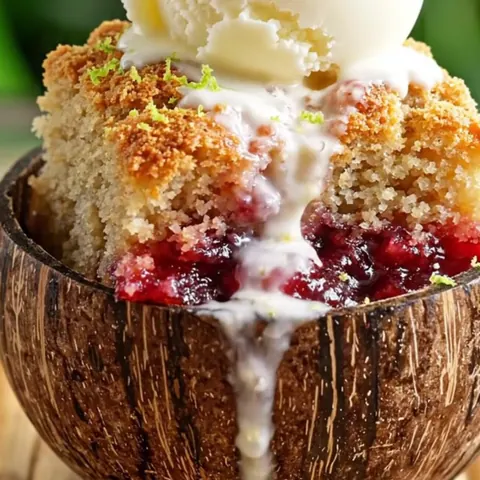
Spoon the warm dump cake into coconut shell bowls or heatproof bowls. Top each serving with a scoop of coconut cream ice cream and finish with a little lime zest.
You’ll need: coconut cream ice cream · lime zest · ripe champagne mangoes, peeled and diced
Look for: A scoop of ice cream is softening and melting over the warm fruit and crust.
Tip: Add the ice cream just before serving so it softens over the warm dessert without melting completely.
Checkpoint
After resting for ten minutes with the lid off, the syrup should have thickened enough to hold its shape in a spoon, and the crust should lift in neat pieces without crumbling into the fruit. The dessert should be warm, not hot, so the coconut ice cream melts gently rather than instantly. When scooping, the portions should show a golden top, a layer of soft cake and a pool of mango syrup beneath. Add the lime zest only after the bowls are filled, so the zest stays bright and fragrant.
Doneness
How to tell it’s done
The dessert is done when the top is evenly golden, the coconut and macadamia nuts look toasted and the edges of the fruit bubble visibly around the sides of the pot. Insert a toothpick into the thickest part of the topping: it should come out with moist crumbs and no raw batter clinging to it. The mango beneath should look thick, glossy and syrupy when you lift a spoon from the side of the pot. Because this dessert contains no raw meat, poultry or eggs, there is no safe internal temperature to check, and doneness is judged by color, texture and the toothpick test. If the surface still looks pale after the full cooking time, cook for another fifteen minutes on high before checking again.
Avoid these
Common mistakes
The most common mistake is stirring the layers together. The topping is meant to sit on the fruit so that the mango cooks into a syrup while the coconut and nuts toast on top; stirring turns the dish into a dense, uneven mixture and the crust never forms. Another frequent error is lifting the lid to check too often, which releases heat and extends the cooking time. Using unripe or very hard mango produces a dry, tart syrup, so choose fruit that is fragrant and yields slightly. Pouring the butter unevenly leaves dry patches of cake mix that stay powdery. Finally, avoid cooking on low instead of high unless you plan for a much longer cooking time, because the topping will not toast properly and the mango will not reduce to a thick syrup.
Better results
Tips
Tip 1
Scoop from the bottom of the pot rather than the top so each serving includes both golden crust and syrupy mango. The bottom layer is the most saturated with juice and gives the best texture when served warm. Keep a bowl of extra coconut ice cream in the freezer so that each serving can be finished at the table as guests arrive.
Tip 2
Use a serving spoon with a flat edge to lift the crust cleanly. If you prefer neat portions, let the dessert rest uncovered for the full ten minutes, which allows the syrup to thicken. For a brighter finish, grate a little lime zest over the ice cream just before serving, because the zest loses its fragrance quickly once exposed to air.
Make it yours
Variations
Extra toasted coconut
Toast an extra half cup of shredded coconut in a dry skillet until golden, then scatter it over the top of the dessert before serving for a deeper, nuttier crunch and more visible color.
Lime and mango bright
Add the zest of one lime to the diced mango before layering, so the citrus perfumes the syrup as it cooks. The fruit stays fresh and lively against the rich butter and coconut topping.
Warm rum-free syrup finish
Warm a few spoons of the mango syrup from the pot with a splash of coconut milk and drizzle it over each portion. This adds a glossy sauce without changing the ingredients of the original dessert.
Individual cups
Divide the layers evenly among six oven-safe ramekins and bake at 350°F (175°C) for 30 to 35 minutes until golden on top. Serve each cup in its dish with ice cream.
On the table
Serving suggestions
Serve the dump cake warm in coconut shell bowls or heatproof bowls, with a generous scoop of coconut cream ice cream melting over the top. The contrast between the warm toasted crust, the jammy fruit and the cold ice cream is the reason this dessert works so well. A final grating of lime zest adds brightness and keeps the sweetness from feeling heavy, especially after a rich meal. Offer small spoons so guests can take a scoop of crust and a little of the mango syrup in each bite.
For a relaxed gathering, set the slow cooker on a warm surface on the serving table with a ladle and a stack of bowls nearby. Pair it with iced tea, sparkling water or a light tropical drink that echoes the fruit flavors. Keep the ice cream in a freezer-safe container and let guests add their own scoop, so every portion is served at the right temperature. The dessert holds its warmth well on the lowest setting for an hour, which makes it easy to serve in stages during the evening.
Leftovers
Storage & make-ahead
- Fridge
- Store leftovers covered in the refrigerator for up to three days, and cool them within two hours before covering.
- Freezer
- Freezing is not recommended, because the mango becomes watery and the crust loses its toasted texture after thawing.
- Reheat
- Warm single portions in the microwave for 30 to 45 seconds until just warm, then add fresh ice cream and lime zest.
Leftover dump cake keeps well for up to three days in an airtight container in the refrigerator. Let it cool for no more than two hours at room temperature before covering and refrigerating, so the fruit does not stay in the danger zone. Store the ice cream separately in the freezer, and keep the lime zest in a sealed container so it stays fragrant. When you are ready to eat the leftovers, portion the cake into a bowl and serve it cold or warm it briefly as described in the reheat note. The crust softens over time, but the flavor of the mango and coconut remains bright and pleasant for the full storage period.
Make ahead
You can prepare the dessert in parts a few hours before the cooking begins. Peel and dice the mango up to four hours ahead, then cover it tightly and keep it chilled in the refrigerator. Toast and chop the macadamia nuts a day ahead and store them in an airtight jar at room temperature. Measure the coconut cake mix and shredded coconut into separate containers so the layering takes just a few minutes. Melt the butter just before pouring so it is warm but not hot. Once everything is layered, the slow cooker should go on high straight away, because the fruit should not sit assembled for long at room temperature. The finished dessert is best served the day it is cooked.
Questions
Frequently asked questions
Can the dump cake be made ahead of time?
Peel and dice the mango up to four hours ahead and keep it chilled, and toast the macadamia nuts a day in advance. Layer and cook the dessert shortly before serving rather than leaving it assembled, since the fruit should not sit at room temperature for long. Once cooked, the dessert is at its best the same day, when the crust is still crisp and the syrup is thick and glossy.
Why does the topping stay dry in some areas?
Dry patches usually come from pouring the melted butter unevenly or in one spot. Drizzle the butter slowly across the entire surface, covering the corners and edges where the dry cake mix tends to stay powdery. Do not stir the layers to fix it, because that disturbs the crust. A thin extra drizzle of melted butter over any bare spots before cooking usually solves the problem.
Can you use a different type of mango?
Yes. Any ripe, fragrant mango works, although champagne mangoes are smaller and sweeter. Choose fruit that gives slightly when pressed and smells sweet at the stem. Use about four medium mangoes in place of five cups of diced fruit, and check the sweetness before cooking. Very firm or underripe mango produces a tart, dry syrup and a less pleasant texture.
How do you know the dessert is fully cooked?
The top should be evenly golden with toasted coconut and macadamia nuts, the sides should bubble gently, and a toothpick inserted in the thickest part should come out with moist crumbs and no raw batter. The mango beneath should look thick and glossy. If the surface is still pale after two and a half hours on high, cook for another fifteen minutes and check again.
Can the recipe be made without macadamia nuts?
Yes, although the flavor changes. Toasted pecans or slivered almonds can take the place of the macadamia nuts, using the same three-quarter cup measure. Toast them in a dry skillet for three to four minutes first to bring out their flavor. Keep in mind that the nuts are a tree nut, so anyone with a nut allergy should avoid this swap as well as the original recipe.
Everything in one place: the recipe card below gathers the ingredients, steps and estimated nutrition, ready to print.
Recipe card
Tropical Crockpot Mango Coconut Macadamia Dump Cake
A dump-and-go slow cooker dessert with ripe mango, coconut cake mix, shredded coconut and macadamia nuts that toast into a golden crust over jammy fruit. Serve warm with coconut ice cream.
- Prep
- Cook
- Rest
- Total
- Servings
- one 6-quart slow cooker dump cake
Ingredients
- 5 cups ripe champagne mangoes, peeled and diced
- 1 box coconut cake mix, dry
- 1 cup shredded sweetened coconut
- 3/4 cup roasted macadamia nuts, chopped
- 1 stick (1/2 cup) unsalted butter, melted
To serve
- lime zest for serving
- coconut cream ice cream for serving
Instructions
Prepare the mango. Peel the mangoes and cut the flesh away from the pit. Dice it into bite-size cubes, about 1/2 inch, and spread them evenly across the bottom of the slow cooker insert.
Layer the dry topping. Sprinkle the dry coconut cake mix evenly over the mango. Scatter the shredded sweetened coconut over the cake mix, then add the chopped macadamia nuts in an even layer.
Add the melted butter. Drizzle the melted butter slowly and evenly over all the dry layers, covering as much of the surface as you can. Leave the mixture unstirred.
Slow cook on high. Cover the slow cooker with the glass lid. Cook on HIGH for 2 1/2 hours, without lifting the lid, until the coconut and macadamia nuts toast and the mango bubbles underneath.
Check the golden crust. Insert a toothpick into the thickest part of the topping. It should come out with moist crumbs and no raw batter, and the mango should be soft and syrupy beneath.
Rest and scoop. Turn off the slow cooker and let the dump cake rest uncovered for 10 minutes so the mango syrup thickens slightly. Scoop into bowls, keeping the crust on top of each portion.
Serve with coconut ice cream. Spoon the warm dump cake into coconut shell bowls or heatproof bowls. Top each serving with a scoop of coconut cream ice cream and finish with a little lime zest.
Allergens: Gluten, Eggs, Milk, Tree nuts, Sulfites
Nutrition (estimated, per serving)
- Calories
- 520 kcal
- Protein
- 5 g
- Carbs
- 68 g
- Fat
- 26 g
- Fiber
- 4 g
- Sugar
- 44 g
- Sodium
- 420 mg
Estimates only: values vary with brands, substitutions and portion sizes.
Recipe by EasyCooks Kitchen · easycooksrecipes.com
Share this recipe
Send it to someone who’d love it, or save it for later.
Spotted a mistake in this recipe? Let us know.
Keep cooking


