Crispy Double-Fried Buffalo Blue Cheese Wings
Achieve the ultimate pub-style crunch at home with this foolproof double-fry technique. Tossed in a vodka-spiked starch coating and finished with a velvety buffalo butter sauce and tangy Gorgonzola, these wings are the gold standard for crispy.
Published 9 min read
- Total time
- Prep
- Cook
- Rest
- Serves
- 4
- Makes 2 pounds wings
- Cuisine
- American
- Calories
- 650
- per serving, estimated

On this page16 sections
Ever wondered why restaurant buffalo wings have that shatteringly crisp texture that never seems to go away? The secret isn't just the fryer, but a specific combination of ingredients that creates a unique surface structure. By using a touch of vodka and potato starch, you can replicate that professional-grade crunch in your own kitchen. This method produces a light, blistered crust that holds up perfectly under a rich, velvety buffalo butter sauce, ensuring every bite remains satisfyingly crispy from the first wing to the last.
This recipe focuses on the physics of frying to deliver the ultimate buffalo wing experience. By combining a vodka-based liquid coating with potato starch, the crust dries out rapidly in the hot oil, creating microscopic bubbles that provide the characteristic crunch. The double-frying method ensures the meat is fully cooked and tender while allowing the exterior to crisp up without burning. Finished with a classic emulsified buffalo butter sauce, these wings are designed for those who appreciate the perfect balance of heat, tang, and texture.
The appeal
Why you’ll love it
The use of vodka is a professional culinary trick because alcohol has a lower boiling point and evaporates faster than water. When it hits the hot oil, it leaves behind a drier, more porous crust that fries up significantly crispier than a standard flour or cornstarch coating. The potato starch adds a delicate, airy crunch that is superior to heavier breadings, ensuring the wings remain light and avoid becoming dense or greasy during the frying process.
The double-fry technique is essential for achieving the perfect texture. The first fry at a moderate 350°F cooks the chicken through while setting the structure of the crust. Allowing the wings to rest for 4 minutes lets the internal temperature stabilize and moisture redistribute. The final, high-heat flash fry at 390°F creates a deep, golden-brown finish and ensures the outer layer is completely dehydrated and firm, providing that signature snap that defines a high-quality buffalo wing.
What you need
Ingredients
Makes 2 pounds wings.
Wings
Buffalo Sauce
Topping
Contains:
- Gluten
- Milk
Tools
Equipment
- Large mixing bowl
- Deep fryer or Dutch oven
- Thermometer
- Wire cooling rack
- Whisk
- Saucepan
Swaps
Substitutions
Instead ofPotato starch
UseCornstarch can be used, though potato starch provides a slightly lighter, glassier crunch.
Instead ofVodka
UseWater can be used, but alcohol evaporates faster, helping to create a drier, crispier crust.
Good to know
Notes
For the best results, use a high-smoke point oil such as peanut or vegetable oil. It is crucial to maintain the oil temperature accurately; use a digital thermometer to monitor the oil throughout the process, as fluctuations can result in oily or undercooked wings. If you find the potato starch is not adhering, ensure the wings are thoroughly dried before applying the vodka and starch mixture. Always work in batches to avoid overcrowding the fryer, which can cause the oil temperature to drop too quickly.
The buffalo sauce emulsion is a delicate balance. Keeping the butter cold ensures it incorporates slowly into the cayenne sauce, creating a creamy, stable emulsion rather than a separated, oily mess. If the sauce begins to separate, remove it from the heat and whisk in a teaspoon of cold water to bring it back together. While Gorgonzola is the classic pairing, you can use any high-quality blue cheese that you prefer. Ensure your blue cheese is cold when crumbled over the hot wings for the best contrast.
Prep
Before you start
Before you begin, ensure your workspace is organized and all ingredients are measured. Pat the chicken wings completely dry using paper towels; excess surface moisture is the enemy of a crispy crust. Set up your deep fryer or a heavy-bottomed pot with enough oil to submerge the wings, and have a wire cooling rack placed over a baking sheet ready for the resting and cooling stages. Keep your thermometer handy to monitor oil temperatures, as precision is vital for the double-fry technique to work correctly.
Step by step
Method
Phase 1
Coating and Preparation
Step 1: Prepare and Coat the Wings
Place the chicken wings in a large mixing bowl. Add the vodka and salt, tossing thoroughly to coat each piece. Sprinkle the potato starch over the wings and toss again until every wing is evenly dusted with a thin layer of starch, which will create the microscopic blisters needed for that signature crunch.
You’ll need: chicken wings · vodka · salt · potato starch
Look for: Wings should be evenly coated with a dry, white layer of starch.
Tip: Ensure the wings are patted dry with paper towels before adding the vodka to prevent clumping.
Checkpoint
The wings should be coated in an even, dry, and opaque layer of potato starch. There should be no visible clumps of wet flour or pools of liquid at the bottom of the mixing bowl. The mixture should feel tacky and well-adhered to the surface of the chicken, ensuring no bald spots remain on the skin.
Phase 2
Double-Frying
Step 2: Double-Fry Technique
Heat oil to 350°F (177°C) and fry the wings for 8 minutes. Remove and let them rest on a wire rack for 4 minutes to allow the moisture to redistribute. Increase the oil temperature to 390°F (199°C) and flash-fry the wings for an additional 3 minutes, or until the internal temperature reaches 165°F (74°C).
You’ll need: chicken wings
Internal temperature 165°F (74°C)
Look for: Wings should be deep golden brown and feel rigid to the touch.
Tip: Using a wire rack prevents the bottom of the wings from becoming soggy during the rest period.
Checkpoint
After the first fry, the wings will be lightly golden but still soft. After the second fry, the wings should have a deep, mahogany-golden color, feel very rigid, and sound crispy when moved. The oil should be clear and bubbling actively around the wings, and no lingering raw spots should be visible.
Phase 3
Emulsification and Finishing
Step 3: Emulsify Sauce and Serve
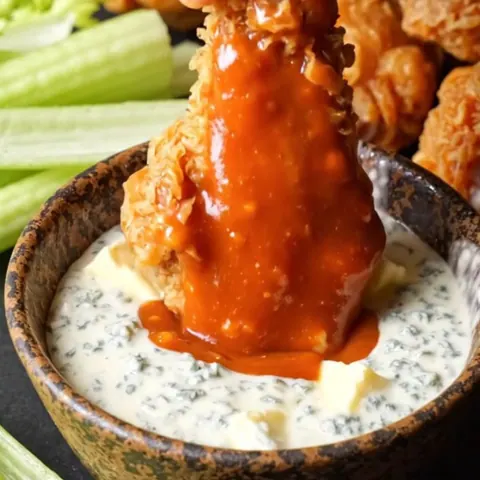
In a small saucepan over low heat, combine the cayenne pepper sauce and cold butter. Whisk constantly as the butter melts, emulsifying it into the sauce to create a velvety, glossy consistency. Toss the double-fried wings in the buffalo butter sauce immediately, then top with crumbled Gorgonzola blue cheese before serving.
You’ll need: cayenne pepper sauce · cold butter · Gorgonzola blue cheese
Look for: The sauce should be thick enough to coat the back of a spoon.
Tip: Adding the butter while cold helps the emulsion stay stable and prevents the sauce from breaking.
Checkpoint
The buffalo sauce must be smooth, opaque, and glossy, with no visible pools of melted butter on the surface. When tossed, the sauce should cling to every crevice of the crispy skin. The blue cheese crumbles should look fresh and distinct, providing a sharp, cold contrast to the hot, spicy wings.
Doneness
How to tell it’s done
The chicken wings are fully cooked when the internal temperature reaches 165°F (74°C) as measured by a meat thermometer inserted into the thickest part of the wing. Visually, the skin should be a deep, vibrant golden brown, and the crust should appear blistered and rigid. If you tap the skin with a utensil, it should sound hollow and feel firm, indicating that the starch coating has achieved the desired level of crispness and is ready to be tossed in the buffalo butter sauce.
Avoid these
Common mistakes
A common mistake is overcrowding the fryer, which drops the oil temperature and leads to soggy, greasy wings. Always fry in small batches to maintain a steady temperature. Another error is failing to let the wings rest between the two frying stages; this rest period is critical for moisture release, and skipping it will prevent the second fry from achieving maximum crispness. Finally, be careful not to overheat the buffalo sauce; if the butter melts too fast or the sauce boils, the emulsion will break and become oily.
Cook safely
Food safety
Safe internal temperatures
Cook to at least these temperatures, measured with an instant-read thermometer in the thickest part.
| Food | Minimum internal temperature |
|---|---|
| Poultry | 165°F (74°C) |
Better results
Tips
Tip 1
To maximize the crispiness, let the coated wings sit on a wire rack for about 5 to 10 minutes before the first fry. This allows the potato starch to hydrate slightly from the moisture on the surface of the chicken, forming a more stable crust that is less likely to slide off during the frying process. This extra step ensures a more uniform coating that results in a better overall texture when the wings are finished.
Tip 2
If you are preparing a large quantity of wings for a gathering, you can complete the first fry stage up to two hours in advance. Simply remove the wings from the oil when they are pale golden and let them cool completely on a wire rack at room temperature. When ready to serve, perform the second fry at 390°F (199°C) until they are golden and crispy. This allows you to serve hot, fresh, crispy wings without spending the entire time standing at the stove.
Make it yours
Variations
Garlic Parmesan Wings
Replace the buffalo sauce with a mixture of melted butter, minced garlic, and finely grated Parmesan cheese. Toss the double-fried wings in this mixture instead of the cayenne sauce for a savory, umami-packed alternative that remains just as crispy.
Honey Sriracha Wings
Swap the cayenne pepper sauce for a blend of Sriracha and honey. Emulsify with cold butter as directed to maintain the glossy, velvety finish. The sweetness of the honey provides a great balance to the heat of the Sriracha, creating a sticky, addictive glaze.
On the table
Serving suggestions
Serve the wings immediately while they are piping hot and the sauce is still glossy. The contrast between the intense heat of the buffalo sauce and the cold, sharp tang of the Gorgonzola blue cheese is the highlight of the dish. Arrange them on a large platter with a side of fresh celery hearts to provide a cooling, crunchy palate cleanser that balances the richness of the butter and the heat of the cayenne pepper.
For a complete gastropub experience, consider serving with a side of extra blue cheese dressing for dipping. The combination of the crispy, saucy wing, the creamy blue cheese, and the crisp celery creates a multi-textured experience. Ensure the wings are piled high, allowing the sauce to pool slightly at the bottom of the platter so that guests can dunk the wings further if they desire an extra kick of spice and richness.
Leftovers
Storage & make-ahead
- Fridge
- Keep in an airtight container for up to 3 days. Cool leftovers for no more than 2 hours before refrigerating.
- Freezer
- Not recommended, as the crispy crust will lose its texture upon thawing and reheating.
- Reheat
- Reheat in a 400°F (200°C) oven or air fryer for 5-8 minutes until hot and the crust has regained some of its crispiness.
Store any leftover wings in an airtight container in the refrigerator for up to three days. Keep the sauce separate if possible to maintain the integrity of the crust, although the wings will inevitably lose some of their signature crunch when stored. Ensure that leftovers are cooled completely before sealing them in a container to prevent condensation from making the crust soggy during the storage period in the refrigerator.
Make ahead
You can prep the wings by coating them in the vodka-starch mixture up to 30 minutes before frying. Beyond that, the starch will begin to absorb moisture and become pasty, which will ruin the crispiness. The buffalo sauce can be made ahead of time and stored in the refrigerator, then gently reheated over low heat while whisking to bring it back to a smooth, emulsified state before tossing the freshly fried wings.
Questions
Frequently asked questions
Can these wings be baked instead of fried?
While baking is possible, the double-fry technique is essential for achieving the specific blistered crust and shatteringly crisp texture described. Baking will result in a different, drier texture that does not replicate the pub-style finish of this recipe.
Why is it important to use cold butter for the sauce?
Using cold butter allows the sauce to emulsify properly, creating a thick, glossy, and stable coating. If the butter is melted too quickly or added when warm, the sauce may separate, resulting in a greasy, thin liquid that pools at the bottom of the bowl.
What is the benefit of the resting period?
The resting period after the first fry allows the internal temperature of the chicken to stabilize and moisture to redistribute within the meat. This prevents the wings from becoming overly dry during the second high-heat fry and helps the crust set properly.
Everything in one place: the recipe card below gathers the ingredients, steps and estimated nutrition, ready to print.
Recipe card
Crispy Double-Fried Buffalo Blue Cheese Wings
Achieve the ultimate pub-style crunch at home with this foolproof double-fry technique. Tossed in a vodka-spiked starch coating and finished with a velvety buffalo butter sauce and tangy Gorgonzola, these wings are the gold standard for crispy.
- Prep
- Cook
- Rest
- Total
- Servings
- 2 pounds wings
Ingredients
Wings
- 2 lb chicken wings, split into flats and drums
- 2 tbsp vodka
- 1 tsp salt
- 1 cup potato starch
Buffalo Sauce
- 1/2 cup cayenne pepper sauce
- 6 tbsp cold butter, cubed
Topping
- Gorgonzola blue cheese crumbles, for serving
Instructions
Prepare and Coat the Wings. Place the chicken wings in a large mixing bowl. Add the vodka and salt, tossing thoroughly to coat each piece. Sprinkle the potato starch over the wings and toss again until every wing is evenly dusted with a thin layer of starch, which will create the microscopic blisters needed for that signature crunch.
Double-Fry Technique. Heat oil to 350°F (177°C) and fry the wings for 8 minutes. Remove and let them rest on a wire rack for 4 minutes to allow the moisture to redistribute. Increase the oil temperature to 390°F (199°C) and flash-fry the wings for an additional 3 minutes, or until the internal temperature reaches 165°F (74°C).
Emulsify Sauce and Serve. In a small saucepan over low heat, combine the cayenne pepper sauce and cold butter. Whisk constantly as the butter melts, emulsifying it into the sauce to create a velvety, glossy consistency. Toss the double-fried wings in the buffalo butter sauce immediately, then top with crumbled Gorgonzola blue cheese before serving.
Allergens: Gluten, Milk
Nutrition (estimated, per serving)
- Calories
- 650 kcal
- Protein
- 38 g
- Carbs
- 22 g
- Fat
- 44 g
- Fiber
- 0.5 g
- Sugar
- 0.2 g
- Sodium
- 850 mg
Estimates only: values vary with brands, substitutions and portion sizes.
Recipe by EasyCooks Kitchen · easycooksrecipes.com
Share this recipe
Send it to someone who’d love it, or save it for later.
Spotted a mistake in this recipe? Let us know.
Keep cooking


