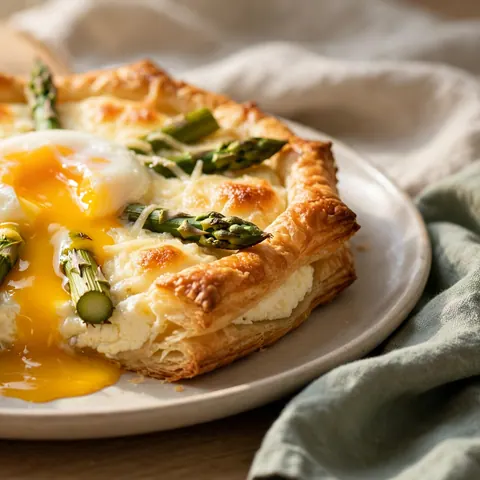
Flaky Asparagus and Gruyere Puff Pastry Galette
This elegant puff pastry tart combines buttery, shattering layers with melted Gruyere, tender roasted asparagus, and perfectly baked eggs for a sophisticated meal.
Published 12 min read
- Total time
- Prep
- Cook
- Serves
- 4
- Makes one 10-inch galette
- Cuisine
- French-inspired
- Calories
- 420
- per serving, estimated

On this page16 sections
Discover the art of creating a bakery-style savory tart in your own home with this simple recipe. This puff pastry galette combines the crunch of buttery, golden pastry with the rich, nutty notes of melted Gruyere and the fresh snap of seasonal asparagus. It is an ideal dish for those who appreciate elegant flavors and beautiful presentation without the need for complicated techniques or hours spent in the kitchen. Enjoy a restaurant-quality meal that is perfect for any occasion.
This puff pastry galette serves as a versatile dish that works perfectly for a sophisticated brunch, a light lunch, or an elegant dinner starter. By using high-quality store-bought puff pastry, you skip the labor-intensive process of folding butter into dough while still achieving those characteristic, delicate, and shattering layers. The combination of creamy Dijon-infused ricotta, savory melted Gruyere, and tender asparagus creates a balanced flavor profile that highlights the freshness of the vegetables. Finishing the dish with eggs and prosciutto adds a luxurious touch that makes this tart feel like a special treat. Follow these straightforward steps to master a dish that is as visually stunning as it is delicious, bringing a touch of French culinary finesse to your table with minimal effort.
The appeal
Why you’ll love it
The method of scoring the puff pastry border is essential for achieving the signature high-rimmed look of a traditional galette. By creating this perimeter, you encourage the pastry to puff upward during the initial high-heat bake, which creates a structured edge that holds the filling securely. This technique not only improves the final presentation but also ensures that the center of the tart remains light and crispy rather than weighed down by the ingredients.
The staged baking process is the secret to a perfectly cooked tart. Baking the pastry and vegetables first allows the dough to develop its structure and crispness before the moisture from the eggs is introduced. Adding the eggs in the final six minutes ensures that the delicate proteins remain creamy and moist, preventing the yolks from overcooking or turning rubbery, which is a common issue when baking eggs for longer periods at high temperatures.
What you need
Ingredients
Makes one 10-inch galette.
Contains:
- Gluten
- Eggs
- Milk
- Mustard
Served raw or lightly cooked
The eggs are served with a soft yolk. Use pasteurized eggs for vulnerable groups.
Tools
Equipment
- Baking sheet
- Parchment paper
- Paring knife
- Offset spatula
- Cheese grater
Swaps
Substitutions
Instead ofGruyere
UseEmmental or Swiss cheese
Instead ofProsciutto
UseThinly sliced ham
Instead ofDijon ricotta
UsePlain ricotta mixed with 1 tsp Dijon mustard
Good to know
Notes
Choose a high-quality, all-butter puff pastry for the best flavor and texture. If your pastry is frozen, ensure it is thawed completely in the refrigerator before rolling it out to prevent it from cracking. If the dough feels too soft or sticky while you are scoring the border, return it to the refrigerator for ten minutes to firm up before proceeding with the assembly.
For the equipment, a heavy-duty baking sheet is recommended to promote even heat distribution, which is vital for the pastry to rise correctly. If you do not have an offset spatula, you can use a flat butter knife to spread the ricotta mixture evenly. Always ensure your asparagus is trimmed to uniform lengths so that the tart looks professional and cooks evenly across the entire surface area once it enters the oven.
Prep
Before you start
Before you begin, ensure your oven is preheated to the correct temperature of 400°F (205°C). Having a stable, hot environment is critical for the puff pastry to rise properly. Prepare your workspace by laying out a sheet of parchment paper, which will make transferring the tart easy and prevent any sticking. Gather all your ingredients, including the cheese and asparagus, and keep them within reach. If you are using frozen puff pastry, verify that it has been fully thawed in the refrigerator according to the package instructions. Having everything measured and ready allows you to assemble the galette quickly, which is important for maintaining the temperature of the pastry dough during the assembly process.
Step by step
Method
Phase 1
Pastry and Filling Assembly
Step 1: Prepare the Pastry Base
Preheat your oven to 400°F (205°C). Roll out the puff pastry sheet on a parchment-lined baking sheet. Using a sharp paring knife, gently score a 2-centimeter border around the entire edge of the pastry, being careful not to cut all the way through the dough. This border will help the rim rise beautifully during the baking process to create a distinct, crispy frame for your filling.
You’ll need: puff pastry
Look for: The pastry is evenly rolled and the border is clearly marked.
Tip: Keep the puff pastry chilled until the moment you are ready to use it to ensure the butter layers remain firm for maximum puff.
Step 2: Assemble the Filling
Spread the Dijon ricotta evenly over the area inside the scored border. Sprinkle the shredded Gruyere cheese across the ricotta layer, then arrange the trimmed asparagus spears neatly on top of the cheese. Ensure the asparagus spears are distributed evenly so they cook at a consistent rate throughout the baking time, leaving the scored border clear of any ingredients to ensure proper rising.
You’ll need: Dijon ricotta (contains mustard) · shredded Gruyere cheese · trimmed asparagus spears
Look for: The ricotta and cheese are spread evenly and asparagus is well arranged.
Tip: Trim the woody ends off the asparagus spears to ensure they are tender and cook through at the same speed as the pastry.
Checkpoint
The pastry should be neatly scored with a clear, visible border that separates the rim from the central filling area. The Dijon ricotta should be spread in a thin, even layer, and the Gruyere should be distributed uniformly to ensure every bite contains a balance of flavors. The asparagus spears should be arranged in a single, orderly layer, ensuring they do not overlap excessively, which would prevent even cooking. At this stage, the tart should look organized and intentional, with the pastry edges clean and the center well-prepared for the initial bake. Ensure the baking sheet is ready to move directly into the oven to maintain the ideal texture of the dough.
Phase 2
Initial Oven Bake
Step 3: Initial Bake
Place the baking sheet into the preheated 400°F (205°C) oven. Bake for 12 minutes. The pastry rim should start to rise and turn a light golden color, while the asparagus should begin to soften slightly under the heat. This initial stage of baking ensures that the base of the tart remains crisp and prevents it from becoming soggy when the final toppings are added later.
You’ll need: puff pastry
Look for: The pastry rim is puffed and starting to turn golden brown.
Tip: Watch the oven closely during these twelve minutes as puff pastry can brown very quickly depending on the specific oven model used.
Checkpoint
After twelve minutes, the pastry rim should have visibly risen and taken on a light, golden-brown hue. The asparagus spears should appear slightly wilted but still vibrant green, and the cheese should be melted and incorporated with the ricotta. The center of the pastry should be dry to the touch, indicating that it has begun to set and will be sturdy enough to support the eggs. If the pastry looks unevenly browned, you may rotate the pan at this point. The kitchen should smell of toasted butter and melted cheese, signaling that the base is perfectly prepared to receive the final toppings for the second bake.
Phase 3
Final Protein Addition
Step 4: Add Eggs and Prosciutto
Carefully remove the baking sheet from the oven. Crack the two eggs into the center of the tart among the asparagus. Drape the prosciutto ribbons around the eggs. Return the sheet to the oven and bake for an additional 6 minutes until the egg whites are set and the yolk is creamy and glossy, reaching an internal temperature of 160°F (71°C) for safety.
You’ll need: large eggs · prosciutto
Internal temperature 160°F (71°C)
Look for: The egg whites are opaque and set, and the prosciutto is slightly crisped.
Tip: If the egg whites are not set after six minutes, return the tart to the oven for one or two minutes more until ready.
Checkpoint
Once the final six minutes of baking are complete, the galette will have transformed into a cohesive, golden-brown tart. The egg whites should be completely set and opaque, providing a beautiful contrast to the bright, tender asparagus and the rich, melted Gruyere. The prosciutto should have achieved a delicate, crispy texture, adding a savory depth to the dish. The overall appearance should be inviting, with the pastry rim standing tall and airy. The tart is now ready to be removed from the oven and should be allowed to rest for just a moment before slicing, ensuring that the warm, creamy yolks stay perfectly intact during serving.
Doneness
How to tell it’s done
The galette is done when the pastry rim has puffed significantly and reached a deep, uniform golden-brown color. The asparagus should be tender when pierced with a knife, and the cheese should be bubbling and slightly browned in spots. Most importantly, the eggs must be checked for safety; the whites should be completely opaque and set, while the yolks should be glossy and creamy. Use a kitchen thermometer to ensure the eggs reach an internal temperature of 160°F (71°C). The prosciutto should appear slightly crisped and darkened at the edges, indicating that the flavors have melded perfectly with the heat of the oven during the final stage of the baking process.
Avoid these
Common mistakes
A common mistake is failing to score the border deeply enough, which prevents the pastry from rising into that beautiful, airy rim. Another error is over-crowding the center of the tart, which can trap excess moisture and lead to a soggy bottom rather than a crisp, golden base. Ensure you leave enough space for the eggs to settle properly. Additionally, rushing the initial bake can result in undercooked pastry, so be patient and wait for that golden color to develop before adding the final toppings. Finally, avoid using eggs that are too cold; bringing them to room temperature for a few minutes before cracking them can help them cook more evenly in the final stage.
Cook safely
Food safety
Safe internal temperatures
Cook to at least these temperatures, measured with an instant-read thermometer in the thickest part.
| Food | Minimum internal temperature |
|---|---|
| Egg dishes | 160°F (71°C) |
Raw or lightly cooked ingredients
The eggs are served with a soft yolk. Use pasteurized eggs for vulnerable groups.
Better results
Tips
Tip 1
To achieve an even deeper color on your puff pastry, you may lightly brush the scored border with a simple egg wash made from one beaten egg and a teaspoon of water before the initial bake. This step is optional but provides a professional, glossy finish that enhances the visual appeal of the tart. Ensure you avoid getting any egg wash on the cut edges of the pastry, as this can seal the layers and prevent them from rising to their full, airy potential.
Tip 2
Experimenting with fresh herbs can add another dimension to this dish. A light sprinkle of fresh thyme or chives over the cheese before baking pairs beautifully with the Gruyere and asparagus. If you prefer a bit of heat, a pinch of crushed red pepper flakes over the asparagus provides a subtle contrast to the richness of the ricotta. Always add delicate fresh herbs after baking to maintain their bright color and vibrant, fresh flavor profile, ensuring each bite is perfectly balanced.
Make it yours
Variations
Smoked Salmon and Dill
Replace the prosciutto with smoked salmon strips added after baking. The cool, silky salmon contrasts beautifully with the warm, buttery pastry and the melted cheese. Finish with a generous sprinkle of fresh dill for a bright, herbal note that elevates the entire dish.
Mushroom and Thyme
Add sautéed cremini mushrooms to the ricotta base before placing the asparagus. The earthy mushrooms provide a savory depth that complements the Gruyere perfectly. A sprinkle of fresh thyme leaves before serving adds an aromatic element that ties all the rich, savory flavors together beautifully.
Caramelized Onion
Spread a thin layer of slow-cooked caramelized onions over the ricotta before adding the cheese and asparagus. The natural sweetness of the onions balances the saltiness of the Gruyere and prosciutto. This addition creates a sophisticated flavor profile that is ideal for a more formal brunch setting.
Goat Cheese and Lemon
Substitute the ricotta with crumbled goat cheese for a tangy, creamy base. Add a pinch of lemon zest to the cheese before assembling the tart to brighten the flavors. This variation is particularly refreshing and pairs excellently with the crisp, spring-like taste of the fresh asparagus spears.
On the table
Serving suggestions
This galette is best served warm, shortly after it comes out of the oven, to ensure the pastry remains at its peak crispness. Slice the tart into four equal portions using a sharp serrated knife, which will glide through the delicate, flaky layers without crushing them. Serve it alongside a simple side salad tossed with a light vinaigrette to provide a refreshing contrast to the rich, buttery pastry and the creamy egg yolks, creating a well-rounded and satisfying meal for any time of day.
For an elegant presentation, place the galette on a wooden cutting board or a decorative serving platter. You can garnish the finished tart with a few extra fresh asparagus tips or a sprinkle of fresh herbs if desired. Ensure that each serving includes a portion of the baked egg, as the creamy yolk acts as a natural sauce for the asparagus and pastry. Encourage guests to enjoy the tart while it is still warm to fully appreciate the combination of textures and flavors.
Leftovers
Storage & make-ahead
- Fridge
- Store in an airtight container in the refrigerator for up to 2 days. Ensure the tart has cooled for no more than 2 hours before refrigerating.
- Reheat
- Reheat in a preheated oven at 350°F (175°C) for 5 to 8 minutes until the pastry is crisp and the center is warm.
If you have leftovers, allow the galette to cool completely at room temperature for no more than two hours before placing it in an airtight container. Storing it properly prevents the pastry from absorbing excess moisture, which helps maintain its crisp texture. Keep the container in the refrigerator to ensure food safety, and consume the tart within two days for the best quality. When ready to enjoy again, a quick reheat in a warm oven will help revive the flaky texture of the pastry.
Make ahead
You can prepare the tart up to the point of assembly a few hours in advance. Keep the scored and filled pastry on the baking sheet in the refrigerator, covered with plastic wrap, until you are ready to bake. This is an excellent way to save time when hosting guests. Simply remove the tart from the refrigerator and place it directly into the preheated oven. Note that you may need to add one or two minutes to the initial bake time if the pastry is chilled when it enters the oven.
Questions
Frequently asked questions
Can the puff pastry be prepared ahead of time?
Yes, you can assemble the tart up to the point of baking and store it in the refrigerator for a few hours. Keep it covered to prevent the pastry from drying out. When you are ready to bake, simply place the chilled tart into the preheated oven. You might need to extend the initial baking time by a minute or two to account for the colder temperature of the dough, ensuring the pastry still achieves that beautiful golden-brown finish.
How can the pastry be kept crispy after baking?
To ensure the pastry remains crispy, avoid covering the tart while it is still warm, as this traps steam and softens the delicate layers. If you must store the leftovers, let the tart cool completely on a wire rack before placing it in an airtight container. Reheating the tart in a hot oven rather than a microwave is also essential, as the dry heat of the oven will help evaporate any lingering moisture and restore the signature shatteringly crisp texture.
What is the best way to ensure the eggs are cooked perfectly?
The key to perfectly cooked eggs in this recipe is the staged baking process. By adding the eggs during the final six minutes of baking, you allow the whites to set while keeping the yolks creamy and glossy. Using a kitchen thermometer to check that the internal temperature reaches 160°F (71°C) ensures food safety. If the whites are not fully set after the specified time, return the tart to the oven for an additional minute, watching carefully to ensure the yolks remain soft and tender.
Can another type of cheese be used instead of Gruyere?
Yes, you can substitute Gruyere with other high-quality melting cheeses. Emmental or a mild Swiss cheese works well, as they offer a similar nutty flavor and excellent melting properties. You could also use a fontina if you prefer a smoother, creamier melt. Whatever cheese you choose, ensure it is freshly shredded, as pre-shredded cheese often contains additives that can affect how well it melts and blends with the other ingredients in the tart.
Is it possible to make this tart without the prosciutto?
Absolutely, this galette is delicious even without the prosciutto. If you prefer a vegetarian version, you can simply omit the meat or replace it with sun-dried tomatoes or toasted pine nuts for added texture and flavor. The combination of ricotta, Gruyere, and asparagus is already quite rich and satisfying on its own. The prosciutto adds a nice savory, salty element, but the tart remains a wonderful, elegant meal even when prepared as a purely vegetarian dish.
Everything in one place: the recipe card below gathers the ingredients, steps and estimated nutrition, ready to print.
Recipe card
Flaky Asparagus and Gruyere Puff Pastry Galette
This elegant puff pastry tart combines buttery, shattering layers with melted Gruyere, tender roasted asparagus, and perfectly baked eggs for a sophisticated meal.
- Prep
- Cook
- Total
- Servings
- one 10-inch galette
Ingredients
- 1 sheet store-bought or made ahead puff pastry
- 30 g Dijon ricotta (contains mustard)
- 80 g shredded Gruyere cheese
- 150 g trimmed asparagus spears
- 2 large eggs
- 40 g prosciutto
Instructions
Prepare the Pastry Base. Preheat your oven to 400°F (205°C). Roll out the puff pastry sheet on a parchment-lined baking sheet. Using a sharp paring knife, gently score a 2-centimeter border around the entire edge of the pastry, being careful not to cut all the way through the dough. This border will help the rim rise beautifully during the baking process to create a distinct, crispy frame for your filling.
Assemble the Filling. Spread the Dijon ricotta evenly over the area inside the scored border. Sprinkle the shredded Gruyere cheese across the ricotta layer, then arrange the trimmed asparagus spears neatly on top of the cheese. Ensure the asparagus spears are distributed evenly so they cook at a consistent rate throughout the baking time, leaving the scored border clear of any ingredients to ensure proper rising.
Initial Bake. Place the baking sheet into the preheated 400°F (205°C) oven. Bake for 12 minutes. The pastry rim should start to rise and turn a light golden color, while the asparagus should begin to soften slightly under the heat. This initial stage of baking ensures that the base of the tart remains crisp and prevents it from becoming soggy when the final toppings are added later.
Add Eggs and Prosciutto. Carefully remove the baking sheet from the oven. Crack the two eggs into the center of the tart among the asparagus. Drape the prosciutto ribbons around the eggs. Return the sheet to the oven and bake for an additional 6 minutes until the egg whites are set and the yolk is creamy and glossy, reaching an internal temperature of 160°F (71°C) for safety.
Allergens: Gluten, Eggs, Milk, Mustard
Nutrition (estimated, per serving)
- Calories
- 420 kcal
- Protein
- 14.5 g
- Carbs
- 28 g
- Fat
- 28 g
- Fiber
- 2.5 g
- Sugar
- 2 g
- Sodium
- 580 mg
Estimates only: values vary with brands, substitutions and portion sizes.
Recipe by EasyCooks Kitchen · easycooksrecipes.com
Share this recipe
Send it to someone who’d love it, or save it for later.
Spotted a mistake in this recipe? Let us know.
Keep cooking