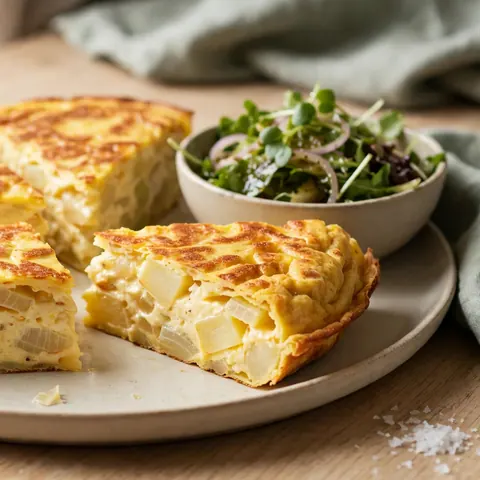
Authentic Spanish Tortilla with Creamy Potatoes
Discover the secret to a perfect Spanish tortilla. This classic recipe uses just four simple ingredients to create a rich, custardy, and incredibly satisfying meal.
Published 13 min read
- Total time
- Prep
- Cook
- Rest
- Serves
- 4
- Makes one 9-inch tortilla
- Cuisine
- Spanish
- Calories
- 380
- per serving, estimated

On this page16 sections
Master the art of the authentic Spanish tortilla with this simple, four-ingredient recipe. By focusing on the traditional technique of poaching potatoes in olive oil, you achieve a result that is both incredibly creamy and full of deep, savory flavor. This classic dish is a testament to the beauty of simple ingredients handled with care, turning humble potatoes and eggs into a sophisticated, comforting meal that is perfect for any occasion, from relaxed brunches to elegant dinners.
The Spanish tortilla, or tortilla de patatas, is a cornerstone of Spanish culinary tradition. Unlike a typical omelette, this dish relies on a slow-poaching technique where potatoes and onions are gently cooked in a generous amount of olive oil until they reach a state of complete tenderness. This process infuses the potatoes with flavor and creates a velvety, custard-like interior that defines an authentic tortilla. Whether served warm or at room temperature, it is a versatile, satisfying dish that showcases the power of minimalist cooking. Follow these steps to achieve a perfectly golden exterior and a moist, flavorful center every single time you prepare it.
The appeal
Why you’ll love it
The secret to a perfect tortilla lies in the gentle poaching of the potatoes. By cooking them in olive oil at a controlled, low temperature rather than frying them, the potatoes absorb the oil and release their starches into the mixture. This creates a rich, creamy consistency that cannot be achieved through other methods. The onion adds a necessary sweetness that balances the earthy potato flavor, creating a harmonious blend that defines the classic taste of this beloved dish.
Allowing the potato and egg mixture to rest before cooking is a vital step that is often overlooked. During this ten-minute rest, the potatoes soak up the beaten eggs, which helps the tortilla hold together during the flip. This resting period also ensures that the temperature of the ingredients is stabilized, leading to more even cooking in the pan. The result is a structure that is firm enough to slice beautifully yet remains incredibly tender and moist in the center.
What you need
Ingredients
Makes one 9-inch tortilla.
Contains:
- Eggs
Served raw or lightly cooked
The eggs are served in a creamy, set state. For safety, use pasteurised eggs if serving to pregnant women, young children, or those with weakened immune systems.
Tools
Equipment
- Mandoline or sharp chef knife
- Heavy-bottomed non-stick skillet
- Large mixing bowl
- Large flat plate for flipping
- Slotted spoon
Swaps
Substitutions
Instead ofYukon Gold potatoes
UseUse any waxy potato variety like red potatoes, which hold their shape well during the gentle poaching process without turning mushy.
Instead ofExtra-virgin olive oil
UseA high-quality virgin olive oil provides the best flavor, though a standard olive oil can be used if a milder taste profile is preferred.
Instead ofYellow onion
UseWhite onions or sweet Vidalia onions work as excellent alternatives to provide that essential aromatic sweetness required for the authentic flavor base.
Good to know
Notes
Choosing the right potato is essential for success. Yukon Gold or other waxy potato varieties are preferred because they maintain their structural integrity during the poaching process. Avoid starchy baking potatoes, as they tend to crumble and fall apart, which will result in a mushy texture rather than the distinct, tender slices you want. The quality of your olive oil also makes a significant difference; use a high-quality extra-virgin variety to ensure the potatoes are infused with a rich, fruity, and authentic depth of flavor.
Equipment plays a supporting role in this recipe. A high-quality, heavy-bottomed non-stick skillet is non-negotiable for achieving that signature golden crust without the tortilla sticking. Ensure your flipping plate is larger than the skillet to make the inversion process smooth and safe. While a mandoline is helpful for achieving perfectly uniform slices, a very sharp chef knife and a steady hand will work just as well. Keep your tools clean and ready to ensure the cooking process flows smoothly from start to finish.
Prep
Before you start
Before you begin cooking, ensure your workspace is clean and all ingredients are measured and ready to go. The poaching process requires your full attention, so keep the olive oil, potatoes, onions, and eggs within easy reach of the stove. Have your non-stick skillet, a slotted spoon for draining, and a large, flat plate for the flipping step prepared in advance. Having everything organized prevents last-minute scrambling and helps you maintain the precise temperature control needed to achieve that perfect, creamy, custard-like texture in your finished Spanish tortilla.
Step by step
Method
Phase 1
Poaching the potatoes and onions
Step 1: Prepare the aromatics and potatoes
Thinly slice the Yukon Gold potatoes and the yellow onion into uniform pieces. Using a mandoline ensures even thickness, which is critical for consistent cooking. Ensure all slices are similar in size so they soften at the same rate during the poaching process. Keep the potatoes and onions separate until ready to combine in the hot oil for the initial poaching step.
You’ll need: Yukon Gold potatoes · yellow onion
Look for: Look for uniformly thin slices that are approximately 1/8 inch thick to ensure they poach evenly and absorb the olive oil effectively without breaking apart during the final assembly.
Tip: Keep a bowl of cold water handy to hold the potato slices if you are not cooking immediately, preventing them from oxidizing and turning brown before they hit the oil.
Step 2: Gently poach in olive oil
Heat the extra-virgin olive oil in a deep skillet to exactly 140°F (60°C). Add the potato and onion slices, ensuring they are fully submerged. Poach them gently for 18 minutes until tender. Do not fry them vigorously; the goal is a slow, confit-style cook that makes the potatoes melt-in-the-mouth creamy. Once tender, drain the potatoes and onions well, reserving the flavorful oil for other uses.
You’ll need: extra-virgin olive oil · Yukon Gold potatoes · yellow onion
Look for: The potatoes are done when a fork slides through them with absolutely no resistance, and the onions have become translucent and sweet, fully infused with the rich olive oil flavor.
Tip: Maintain a steady, low heat throughout the poaching process to avoid browning the edges of the potatoes, which should remain pale, soft, and completely tender throughout the entire cooking duration.
Checkpoint
At the end of this phase, the potatoes and onions should be completely tender, easily yielding to a fork without breaking into a mash. They should be translucent and infused with the rich, aromatic olive oil. Ensure the oil has been drained effectively, as excess oil can make the final tortilla feel greasy. The mixture should look soft and cohesive, with the onions having lost their raw, sharp bite, replaced by a deep, savory sweetness that forms the foundational flavor of your authentic Spanish tortilla.
Phase 2
Combining and resting the mixture
Step 3: Combine with seasoned eggs
In a large mixing bowl, beat the eggs with the salt until well incorporated. Gently fold the warm, drained potato and onion mixture into the beaten eggs. Allow this mixture to rest for 10 minutes. This resting period is essential as it allows the potatoes to absorb some of the egg, creating a cohesive, creamy structure that is the hallmark of a traditional Spanish tortilla, ensuring a uniform texture in every bite.
You’ll need: eggs · salt · Yukon Gold potatoes · yellow onion
Look for: The mixture should look like a thick, chunky batter where the potatoes are completely coated in the egg, and the salt is evenly distributed throughout the entire mass of ingredients.
Tip: Use a gentle hand when folding the potatoes into the eggs to avoid breaking the delicate, tender potato slices, keeping the integrity of the texture intact for the final cooked result.
Checkpoint
The mixture should now be thick, with the potatoes and onions fully coated in the beaten eggs. The resting period is complete when the potatoes have absorbed some of the egg, resulting in a slightly thickened, unified batter. It should smell fragrant and savory, with no signs of separation between the liquid egg and the solid ingredients. This is the moment to check that your seasoning is balanced, as the potatoes and onions will have absorbed the salt, creating a perfectly seasoned base for the final cooking phase.
Phase 3
Searing the final tortilla
Step 4: Sear the tortilla to perfection
Heat a non-stick skillet to 170°F (77°C) and add a small amount of the reserved olive oil. Pour in the egg and potato mixture, spreading it evenly. Cook for 2 minutes, then use a large plate to flip the tortilla carefully. Cook the other side for an additional 2 minutes until the exterior is golden and the center remains creamy and moist. Ensure the eggs reach 160°F (71°C) at the center to be fully set while maintaining a luscious, tender mouthfeel.
You’ll need: eggs · Yukon Gold potatoes · yellow onion · extra-virgin olive oil · salt
Internal temperature 160°F (71°C)
Look for: The tortilla is ready when the edges are firm and golden, and the center is set but still retains a slight, luxurious give when pressed gently with a spatula.
Tip: When flipping, place the plate over the pan, invert quickly and confidently, then slide the tortilla back into the pan to ensure the uncooked side sears evenly without breaking.
Checkpoint
The tortilla is finished when the exterior is a deep, appetizing golden-brown, providing a slight resistance when touched. The center should be set and firm yet feel incredibly moist and tender to the touch. The aroma should be rich with the scent of cooked eggs and olive oil. If you have followed the temperature guidelines, the tortilla will be perfectly set, ready to be sliced into wedges and served immediately while the interior is still warm, creamy, and beautifully textured.
Doneness
How to tell it’s done
The tortilla is done when the exterior has formed a beautiful, golden-brown crust and the center has set to a creamy, moist, and tender consistency. When you press the center gently with a spatula, it should feel firm yet provide a slight, luxurious give. Using a digital thermometer, ensure the center reaches an internal temperature of 160°F (71°C) to guarantee the eggs are fully cooked while maintaining their delicate, silky texture. If the center feels too soft or liquid, continue cooking for another minute, but be careful not to overcook the edges, which should remain tender and light.
Avoid these
Common mistakes
A common mistake is rushing the poaching process by using heat that is too high, which results in crispy, fried potatoes rather than tender, confit ones. The potatoes should be soft and almost melting, not browned or crunchy. Another frequent error is failing to let the potato and egg mixture rest; this resting time is crucial for the potatoes to absorb the egg, which helps the tortilla hold its shape when flipped. Finally, using a pan that is not truly non-stick or failing to use enough oil can cause the tortilla to stick, making the flipping process difficult and potentially ruining the presentation.
Cook safely
Food safety
Safe internal temperatures
Cook to at least these temperatures, measured with an instant-read thermometer in the thickest part.
| Food | Minimum internal temperature |
|---|---|
| Egg dishes | 160°F (71°C) |
Raw or lightly cooked ingredients
The eggs are served in a creamy, set state. For safety, use pasteurised eggs if serving to pregnant women, young children, or those with weakened immune systems.
Better results
Tips
Tip 1
For the best flavor, allow the finished tortilla to sit for at least ten minutes before slicing. This resting time allows the internal structure to firm up slightly, ensuring that each wedge holds its shape perfectly when transferred to a plate. Serving it slightly warm or at room temperature is traditional in Spain, as this allows the complex flavors of the olive oil and the sweetness of the confit onions to shine through more clearly than when served piping hot directly from the pan.
Tip 2
If you find that your tortilla is browning too quickly on the outside before the center is set, simply lower the heat and cover the pan with a lid for the final minute of cooking. This traps the heat and helps the center cook through more evenly without scorching the exterior crust. Always use a generous amount of olive oil for the initial sear to ensure a beautiful, uniform golden color across the entire surface of the tortilla, which is a hallmark of a professional-looking dish.
Make it yours
Variations
Chorizo and Potato Tortilla
Add 100 grams of finely diced, fresh chorizo to the potatoes while they poach. The spicy, smoky oils from the chorizo will infuse the potatoes and eggs, adding a bold layer of flavor that complements the richness of the dish perfectly.
Spinach and Garlic Tortilla
Fold in two cups of fresh, wilted spinach and a clove of minced garlic when combining the potatoes with the eggs. The spinach adds a vibrant color and a fresh, earthy note that balances the richness of the olive oil.
Roasted Red Pepper Tortilla
Incorporate 1/2 cup of diced, jarred roasted red peppers into the egg mixture. The peppers provide a subtle sweetness and a beautiful pop of color, making the tortilla look even more appetizing while adding a slight tang to each bite.
Manchego and Herb Tortilla
Stir in 1/2 cup of grated Manchego cheese and a tablespoon of chopped fresh parsley before cooking the final mixture. The cheese adds a savory, nutty depth, while the herbs provide a fresh finish that elevates the overall flavor profile.
On the table
Serving suggestions
Serve your Spanish tortilla cut into wedges, either as a stand-alone main course or as part of a larger tapas spread. It pairs beautifully with a simple green salad dressed with a bright vinaigrette, which cuts through the richness of the olive oil and eggs. You can also serve it with crusty bread, which is perfect for mopping up any extra juices and adds a delightful crunch that contrasts with the soft, creamy interior of the tortilla, creating a balanced and satisfying meal for your guests.
Consider serving the tortilla alongside some traditional Spanish accompaniments like olives, Marcona almonds, or a side of piquillo peppers. These small bites complement the savory, creamy nature of the tortilla without overpowering it. The key is to keep the pairings simple, allowing the tortilla to remain the star of the plate. Whether you are serving it for a casual weekend brunch or an elegant dinner party, this versatile dish is sure to be a crowd-pleaser that brings a touch of authentic Madrid to your home table.
Leftovers
Storage & make-ahead
- Fridge
- Store in an airtight container for up to 3 days. Ensure it cools to room temperature within 2 hours before refrigerating.
- Reheat
- Reheat gently in a low-temperature oven or a skillet over very low heat until just warmed through to maintain the creamy texture.
Store any leftovers in an airtight container in the refrigerator for up to three days. Ensure the tortilla has cooled completely to room temperature before covering it, but do not leave it out for more than two hours. When you are ready to enjoy it again, bring it to room temperature or warm it gently, as serving it cold can mute the delicate flavors of the olive oil and onions, making the texture feel less creamy and satisfying than it was when freshly prepared.
Make ahead
This dish is perfect for making ahead, as the flavors often improve after sitting for a few hours. You can prepare the entire tortilla in advance and store it in the refrigerator. When you are ready to serve, simply reheat the wedges in a low-temperature oven or a skillet over very low heat until just warmed through. This makes it an excellent choice for hosting, allowing you to focus on your guests while having a delicious, authentic meal ready to be plated at a moment's notice.
Questions
Frequently asked questions
Can this tortilla be made ahead of time?
Yes, this dish is excellent when made ahead. The flavors actually tend to deepen and become more cohesive after sitting for a few hours. You can prepare it in advance and store it in the refrigerator. Before serving, gently warm the wedges in a low-temperature oven or a skillet over very low heat. This ensures the center remains creamy and moist, just as it was when first prepared, making it a convenient and reliable choice for your next gathering or busy weeknight dinner.
Why is it important to rest the potato and egg mixture?
Resting the mixture for ten minutes is a critical step that allows the potatoes to absorb the beaten eggs. This absorption is what creates the cohesive, custard-like structure that is characteristic of an authentic Spanish tortilla. Without this resting time, the ingredients may not bind correctly, making the tortilla difficult to flip and resulting in a less uniform texture. It also helps to stabilize the temperature of the ingredients, which ensures that the tortilla cooks evenly throughout the entire pan, from the edges to the very center.
How can the tortilla be flipped without breaking it?
The key to a successful flip is using a large, flat plate that is wider than your skillet. Place the plate firmly over the pan, then confidently and quickly invert the pan so the tortilla lands on the plate. Then, carefully slide the tortilla back into the pan to finish cooking the other side. Using a high-quality non-stick skillet and ensuring there is enough oil in the pan are also essential to prevent sticking, which makes the entire flipping process much smoother and more reliable.
What is the best way to tell when the center is perfectly cooked?
The center should be set but still retain a slight, luxurious give when pressed gently with a spatula. Using a digital thermometer is the most accurate method; the center should reach an internal temperature of 160°F (71°C). This ensures the eggs are fully cooked to a safe standard while maintaining their signature creamy, tender mouthfeel. Avoid overcooking the center, as this will lead to a dry, rubbery texture that loses the delicate, custardy quality that makes this classic Spanish dish so special and highly regarded.
Is it possible to use a different type of oil for poaching?
While extra-virgin olive oil is the traditional and recommended choice for its rich, fruity flavor, you can use a milder olive oil if you prefer a less pronounced taste. It is important to avoid oils with strong, competing flavors, as the potatoes absorb the oil during the poaching process. The quality of the oil directly impacts the final taste of the tortilla, so choose an oil that you enjoy the flavor of on its own. The goal is to infuse the potatoes with a clean, savory, and rich essence.
Everything in one place: the recipe card below gathers the ingredients, steps and estimated nutrition, ready to print.
Recipe card
Authentic Spanish Tortilla with Creamy Potatoes
Discover the secret to a perfect Spanish tortilla. This classic recipe uses just four simple ingredients to create a rich, custardy, and incredibly satisfying meal.
- Prep
- Cook
- Rest
- Total
- Servings
- one 9-inch tortilla
Ingredients
- 500 g Yukon Gold potatoes, thinly sliced
- 1 large yellow onion, thinly sliced
- 250 ml extra-virgin olive oil
- 6 large eggs, beaten
- 6 g salt
Instructions
Prepare the aromatics and potatoes. Thinly slice the Yukon Gold potatoes and the yellow onion into uniform pieces. Using a mandoline ensures even thickness, which is critical for consistent cooking. Ensure all slices are similar in size so they soften at the same rate during the poaching process. Keep the potatoes and onions separate until ready to combine in the hot oil for the initial poaching step.
Gently poach in olive oil. Heat the extra-virgin olive oil in a deep skillet to exactly 140°F (60°C). Add the potato and onion slices, ensuring they are fully submerged. Poach them gently for 18 minutes until tender. Do not fry them vigorously; the goal is a slow, confit-style cook that makes the potatoes melt-in-the-mouth creamy. Once tender, drain the potatoes and onions well, reserving the flavorful oil for other uses.
Combine with seasoned eggs. In a large mixing bowl, beat the eggs with the salt until well incorporated. Gently fold the warm, drained potato and onion mixture into the beaten eggs. Allow this mixture to rest for 10 minutes. This resting period is essential as it allows the potatoes to absorb some of the egg, creating a cohesive, creamy structure that is the hallmark of a traditional Spanish tortilla, ensuring a uniform texture in every bite.
Sear the tortilla to perfection. Heat a non-stick skillet to 170°F (77°C) and add a small amount of the reserved olive oil. Pour in the egg and potato mixture, spreading it evenly. Cook for 2 minutes, then use a large plate to flip the tortilla carefully. Cook the other side for an additional 2 minutes until the exterior is golden and the center remains creamy and moist. Ensure the eggs reach 160°F (71°C) at the center to be fully set while maintaining a luscious, tender mouthfeel.
Allergens: Eggs
Nutrition (estimated, per serving)
- Calories
- 380 kcal
- Protein
- 12.5 g
- Carbs
- 28 g
- Fat
- 25 g
- Fiber
- 3 g
- Sugar
- 2.5 g
- Sodium
- 1,500 mg
Estimates only: values vary with brands, substitutions and portion sizes.
Recipe by EasyCooks Kitchen · easycooksrecipes.com
Share this recipe
Send it to someone who’d love it, or save it for later.
Spotted a mistake in this recipe? Let us know.
Keep cooking


