Matcha Milk Bread French Toast with Black Sesame Cream
Discover the vibrant fusion of ceremonial matcha and creamy Hokkaido milk bread. This sophisticated French toast features a nutty black sesame chantilly for a café-quality breakfast at home.
Published 12 min read
- Total time
- Prep
- Cook
- Serves
- 2
- Cuisine
- Japanese-fusion
- Calories
- 420
- per serving, estimated

On this page16 sections
Elevate your morning ritual with the sophisticated harmony of Japanese ceremonial matcha and pillowy Hokkaido milk bread. This French toast recipe transforms humble breakfast staples into a refined, café-quality experience that balances earthy, aromatic green tea with the deep, nutty notes of black sesame chantilly. It is the perfect centerpiece for a leisurely weekend brunch, offering a tactile contrast between the caramelized, golden-brown exterior and the tender, set interior that defines a truly exceptional French toast.
The secret to this exceptional French toast lies in the precise balance of high-quality ingredients and careful technique. By using Hokkaido milk bread, you ensure a base that is inherently pillowy and capable of absorbing the rich custard without losing its structure. The ceremonial matcha provides a vibrant color and nuanced, grassy flavor that is beautifully complemented by the nutty, sophisticated black sesame whipped cream. This recipe is designed for those who appreciate the intersection of culinary aesthetics and flavor, providing a clear, step-by-step path to achieving that elusive, perfect bite that balances warmth, texture, and a refined, earthy sweetness in every single mouthful.
The appeal
Why you’ll love it
The method relies on a controlled soaking process that allows the milk bread to absorb the matcha custard deeply, resulting in a uniform texture that is moist and tender throughout. By searing the bread in clarified butter at a steady temperature, the sugars in the honey and the milk solids in the bread caramelize perfectly, creating a crispy, golden-brown crust that protects the set, custard-filled interior from becoming overly moist or soggy during the cooking process.
Furthermore, the combination of ceremonial grade matcha with heavy cream creates a balanced custard that is both vibrant and decadent. The addition of black sesame whipped cream introduces a contrasting flavor profile that is both nutty and slightly bitter, which prevents the dish from being one-dimensionally sweet. This layering of textures and flavors ensures that every bite is complex and satisfying, providing a professional culinary experience that is remarkably accessible for a home cook to replicate consistently.
What you need
Ingredients
Makes 2 servings.
Custard Base
Toast
Topping
Contains:
- Gluten
- Eggs
- Milk
- Sesame
Served raw or lightly cooked
This dish contains eggs that are not fully cooked. Use pasteurised eggs for pregnant women, young children, older adults, and anyone with a weakened immune system.
Tools
Equipment
- Medium mixing bowl
- Fine mesh whisk
- Non-stick skillet
- Piping bag
- Silicone spatula
Swaps
Substitutions
Instead ofHokkaido milk bread
UseThick-cut brioche or challah bread can be used as a suitable alternative for a similarly pillowy, rich texture.
Instead ofCeremonial matcha
UseCulinary grade matcha is an acceptable substitute, though it may provide a slightly more robust, grassy flavor profile compared to ceremonial grade.
Instead ofClarified butter
UseUnsalted butter or ghee can be used for searing, provided the heat is carefully managed to prevent the milk solids from burning prematurely.
Instead ofHoney
UseMaple syrup or agave nectar provide excellent sweetness and viscosity, maintaining the smooth consistency of the custard base throughout the soaking process.
Good to know
Notes
Selecting the right bread is essential for success; Hokkaido milk bread is preferred for its high hydration and dense, pillowy crumb, which stands up best to the custard soak. If you cannot source traditional milk bread, a thick-cut brioche or challah will offer a similar richness, though the final texture may be slightly more delicate. Always ensure your matcha is ceremonial grade to achieve the brightest green color and the most authentic, nuanced flavor profile possible without any lingering bitterness.
Regarding equipment, a high-quality non-stick skillet is non-negotiable for achieving the perfect sear without the bread sticking or tearing. Clarified butter is recommended because it has a higher smoke point than standard butter, allowing for a longer, more controlled sear that ensures the center of the bread is fully cooked and set. A piping bag with a star tip will provide the most professional finish for the black sesame cream, though a simple spoon can be used for a more rustic, home-style presentation.
Prep
Before you start
Before beginning, ensure all ingredients are at room temperature to facilitate even mixing and absorption. Prepare your work station by gathering your whisk, mixing bowl, and piping bag. Cut the Hokkaido milk bread into precise four-centimeter slabs to ensure uniform cooking times. If you have not prepared the black sesame whipped cream, do so now so that it is chilled and ready for piping the moment the toast leaves the pan. Clear your counter space and have your skillet ready on the stovetop, ensuring your thermometer is nearby to verify the internal temperature of the toast during the searing process.
Step by step
Method
Phase 1
Custard and Soaking Phase
Step 1: Prepare the Matcha Custard
In a medium mixing bowl, combine the ceremonial matcha powder with the warm milk. Whisk thoroughly until the powder is fully dissolved and the mixture is completely smooth. Add the eggs, heavy cream, and honey to the bowl. Whisk all components together vigorously until the custard base is uniform, vibrant in color, and well-aerated for optimal absorption into the bread.
You’ll need: ceremonial grade matcha powder · warm milk · large eggs · heavy cream · honey
Look for: The matcha should be fully integrated with no visible clumps, creating a smooth, deep green custard base.
Tip: Sift the matcha powder through a fine-mesh sieve before whisking to ensure a perfectly smooth consistency without any stubborn green tea particles.
Step 2: Soak the Milk Bread
Place the thick Hokkaido milk bread slabs into the bowl with the matcha custard. Allow the bread to soak for exactly three minutes. Carefully turn the slabs once during the soaking process to ensure the custard penetrates the bread evenly without causing the structure to break apart, maintaining the integrity of the dense, pillowy crumb while maximizing flavor absorption.
You’ll need: Hokkaido milk bread
Look for: The bread should feel heavy and fully saturated with the green custard, yet remain intact and pillowy to the touch.
Tip: Use a wide, shallow dish for soaking to ensure the bread slabs can sit flat and absorb the custard evenly across their entire surface area.
Checkpoint
At the end of this phase, the custard should be a vibrant, uniform green with no visible matcha particles. The milk bread should be fully saturated and heavy, having absorbed the liquid evenly without breaking down. Ensure the bread feels set to the touch but retains its shape. This is the crucial moment to verify that the soaking duration has been observed, as an under-soaked center will result in a dry, uneven finish, while over-soaking may cause the delicate milk bread to lose its structural integrity before it ever reaches the hot skillet.
Phase 2
Searing and Caramelization Phase
Step 3: Sear the French Toast
Heat the clarified butter in a non-stick skillet over medium-high heat until it shimmers. Carefully transfer the soaked bread slabs to the pan. Sear each side for three minutes, ensuring a deep golden-brown crust develops while the interior remains set and tender. Cook until the center reaches 160°F (71°C) to ensure the eggs are fully set and the custard is cooked through, resulting in a perfectly textured, warm finish.
You’ll need: clarified butter
Internal temperature 160°F (71°C)
Look for: The edges should be caramelized and golden-brown, with the bread feeling firm yet springy to the touch when pressed gently.
Tip: Maintain a consistent heat level to achieve even caramelization without darkening the delicate matcha color or burning the honey in the custard.
Checkpoint
The toast should now exhibit a deep, uniform golden-brown crust on both sides, with the edges feeling crisp and the center remaining set. The aroma should be rich and buttery, with the subtle, earthy scent of toasted matcha. Check that the internal temperature has reached 160°F (71°C) to ensure the custard is fully set. The toast should look pillowy and feel substantial when lifted with a spatula. If the toast feels moist or lacks structure in the center, it requires additional cooking time to ensure the custard is safe and set.
Phase 3
Final Assembly Phase
Step 4: Finish and Serve
Remove the toasted bread from the skillet and place it onto serving plates. Using a piping bag, apply a dramatic, generous swirl of black sesame whipped cream directly onto the hot surface of the French toast. Serve immediately while the toast is warm and the contrast between the crisp exterior, set interior, and cool, nutty cream is at its peak for the best dining experience.
You’ll need: black sesame whipped cream
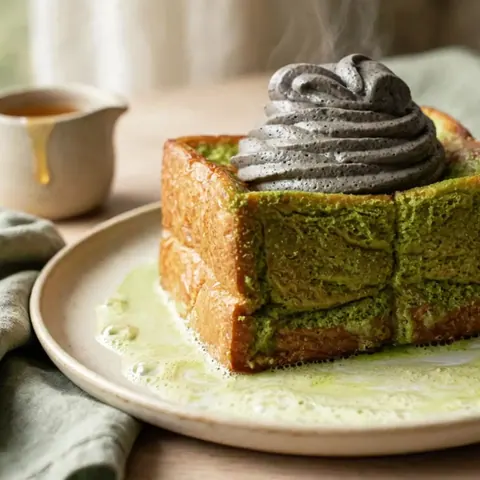
Look for: The cream should hold its shape beautifully against the warm toast, creating a striking visual contrast between the green bread and the charcoal-grey topping.
Tip: For the cleanest presentation, slice the toast into triangles or strips just before serving to reveal the vibrant, consistent green interior of the bread.
Checkpoint
The finished toast should be warm and fragrant, with the black sesame whipped cream maintaining its piped shape against the heat of the bread. The visual contrast between the vibrant green toast and the dark, nutty cream should be striking and clean. Ensure the cream is applied just before serving to prevent it from melting prematurely. The final dish should look inviting, with the textures of the crisp exterior and the pillowy, set interior clearly defined. It is now ready to be enjoyed immediately while the temperature contrast is at its most enjoyable level.
Doneness
How to tell it’s done
The French toast is properly done when the exterior is uniformly golden-brown and crisp, and the interior has transformed into a set, soufflé-like texture. When pressed gently with a spatula, the toast should feel firm yet springy, indicating the custard has fully set. Use a digital thermometer to confirm the center of the toast has reached an internal temperature of 160°F (71°C). This ensures the eggs are completely cooked through, resulting in a safe, creamy, and structurally sound finish that holds its shape beautifully when served on the plate.
Avoid these
Common mistakes
A common mistake is using bread that is too thin, which causes it to disintegrate during the soaking or flipping process; stick to the four-centimeter thickness for the best results. Another pitfall is using a pan that is too cold, which prevents the butter from caramelizing the surface correctly, leading to a greasy rather than crispy exterior. Avoid overcrowding the skillet, as this drops the temperature too quickly and hinders the formation of the golden crust. Finally, ensure the matcha is whisked until completely smooth, as residual clumps will negatively affect the final texture and appearance.
Cook safely
Food safety
Safe internal temperatures
Cook to at least these temperatures, measured with an instant-read thermometer in the thickest part.
| Food | Minimum internal temperature |
|---|---|
| Egg dishes | 160°F (71°C) |
Raw or lightly cooked ingredients
This dish contains eggs that are not fully cooked. Use pasteurised eggs for pregnant women, young children, older adults, and anyone with a weakened immune system.
Better results
Tips
Tip 1
To achieve the most consistent results, always use a thermometer to check the internal temperature of the bread while searing. This practice ensures your toast is perfectly set every time without relying on guesswork. If you find the crust is browning too quickly before the center is set, lower the heat slightly and cover the skillet with a lid for the final minute of cooking, which helps trap the heat and ensures the custard cooks through evenly without burning the delicate exterior.
Tip 2
For a more intense flavor experience, consider lightly toasting the black sesame seeds before grinding them into your whipped cream. This simple step unlocks the natural oils in the seeds, resulting in a deeper, nuttier profile that perfectly complements the grassy notes of the matcha. When piping the cream, start from the center and swirl outwards to create a dramatic, professional-looking peak. Always use a high-quality, full-fat heavy cream to ensure the topping remains stable and maintains its luxurious, airy texture when served on the warm toast.
Make it yours
Variations
Hojicha Infusion
Replace the matcha powder with finely ground hojicha powder for a deep, roasted, and nutty flavor profile. This variation pairs beautifully with the black sesame cream and offers a warmer, more autumnal twist on the traditional matcha-based recipe.
Citrus Zest Twist
Add one teaspoon of freshly grated yuzu or lemon zest to the custard base before soaking the bread. The bright, acidic notes of the citrus cut through the richness of the cream and highlight the floral qualities of the ceremonial matcha.
Maple Pecan Crunch
Sprinkle toasted, chopped pecans over the black sesame cream just before serving. The added crunch provides a wonderful textural contrast to the pillowy bread, while the maple notes enhance the natural sweetness of the honey used in the custard.
Red Bean Filling
Spread a thin layer of sweetened red bean paste between two slices of milk bread before soaking and searing. This creates a decadent, filled French toast that adds a layer of traditional Japanese sweetness to the refined matcha and sesame profile.
On the table
Serving suggestions
Serve the French toast immediately upon removing it from the skillet to preserve the contrast between the hot, crisp exterior and the cool, creamy topping. Arrange the toast on warmed plates to help maintain the serving temperature for as long as possible. A simple garnish of a few toasted black sesame seeds or a tiny dusting of matcha powder can add an extra layer of visual appeal, but ensure these additions are kept minimal to keep the focus on the primary flavors of the dish.
For a complete brunch experience, consider pairing the toast with a light, unsweetened tea or a simple fruit salad to balance the richness of the custard and cream. The goal is to let the unique combination of matcha and black sesame take center stage. Avoid heavy syrups or extra toppings that might overwhelm the delicate flavors. By presenting the toast cleanly and simply, you allow the guest to appreciate the care taken in achieving the perfect texture and the harmonious balance of ingredients in each bite.
Leftovers
Storage & make-ahead
- Fridge
- Keep leftovers in an airtight container for up to 2 days. The cream should be stored separately from the toast to maintain its texture and freshness.
- Freezer
- Freezing is not recommended for this recipe, as the texture of the milk bread and the integrity of the whipped cream will be negatively affected.
- Reheat
- Reheat in a toaster oven at 300°F (150°C) for 5-8 minutes until warmed through and slightly crisp. Do not microwave, as this will make the toast soggy.
Store any leftover French toast in an airtight container in the refrigerator for up to two days. Note that the texture will lose its crispness over time, so it is best enjoyed immediately after preparation. Keep the black sesame whipped cream in a separate, sealed container in the refrigerator to maintain its freshness and prevent it from absorbing any odors. For the best quality, avoid storing the toast with the cream already applied, as this will lead to a soggy texture and compromise the overall presentation of the dish.
Make ahead
You can prepare the matcha custard base up to 24 hours in advance and keep it refrigerated in a sealed jar until you are ready to soak the bread. The black sesame whipped cream can also be made ahead of time and stored in the refrigerator, though it may need a quick re-whisking to regain its volume before piping. While the bread itself should be soaked and cooked fresh for the best texture, having the components prepped significantly streamlines the morning process, making it ideal for a stress-free brunch.
Questions
Frequently asked questions
Can the matcha custard be made without honey?
Yes, honey can be replaced with an equal amount of maple syrup or granulated sugar. Ensure the sweetener is fully dissolved into the custard base to maintain a uniform texture. The choice of sweetener will slightly alter the final flavor profile, but the structural integrity of the French toast will remain consistent regardless of the specific sweetener used.
Why is it important to use clarified butter?
Clarified butter has a higher smoke point than regular butter because the milk solids have been removed. This allows you to sear the bread at a higher temperature for a longer period without the butter burning or turning bitter. This process is essential for achieving a perfectly golden, crispy crust while ensuring the center of the bread is fully cooked and set.
What is the best way to ensure the bread does not fall apart?
Using thick, four-centimeter slabs of Hokkaido milk bread is the most effective way to prevent the bread from falling apart. The dense, pillowy crumb of this specific bread is designed to hold its shape even when saturated with custard. Additionally, handle the bread gently during the soaking and flipping processes to maintain its structural integrity until it hits the hot skillet.
Can this be made ahead of time for a brunch?
While the bread should be soaked and seared fresh to ensure the best texture, the matcha custard and the black sesame whipped cream can be prepared up to 24 hours in advance. Keeping these components prepped in the refrigerator allows for a quick and seamless assembly, ensuring that the final French toast is hot, crisp, and ready to serve with minimal effort.
How can the internal temperature be checked accurately?
Use a digital probe thermometer inserted into the thickest part of the toast while it is in the skillet. Ensure the probe reaches the center of the bread to get an accurate reading. Confirming that the internal temperature has reached 160°F (71°C) is the most reliable way to ensure the eggs are fully set and the French toast is safe and perfectly cooked.
Everything in one place: the recipe card below gathers the ingredients, steps and estimated nutrition, ready to print.
Recipe card
Matcha Milk Bread French Toast with Black Sesame Cream
Discover the vibrant fusion of ceremonial matcha and creamy Hokkaido milk bread. This sophisticated French toast features a nutty black sesame chantilly for a café-quality breakfast at home.
- Prep
- Cook
- Total
- Servings
- 2 servings
Ingredients
Custard Base
- 8 g ceremonial grade matcha powder
- 30 ml warm milk
- 2 large eggs
- 70 ml heavy cream
- 15 g honey
Toast
- 2 slabs (4 cm thick) Hokkaido milk bread
- 20 g clarified butter
Topping
- 1/2 cup black sesame whipped cream, made ahead
Instructions
Prepare the Matcha Custard. In a medium mixing bowl, combine the ceremonial matcha powder with the warm milk. Whisk thoroughly until the powder is fully dissolved and the mixture is completely smooth. Add the eggs, heavy cream, and honey to the bowl. Whisk all components together vigorously until the custard base is uniform, vibrant in color, and well-aerated for optimal absorption into the bread.
Soak the Milk Bread. Place the thick Hokkaido milk bread slabs into the bowl with the matcha custard. Allow the bread to soak for exactly three minutes. Carefully turn the slabs once during the soaking process to ensure the custard penetrates the bread evenly without causing the structure to break apart, maintaining the integrity of the dense, pillowy crumb while maximizing flavor absorption.
Sear the French Toast. Heat the clarified butter in a non-stick skillet over medium-high heat until it shimmers. Carefully transfer the soaked bread slabs to the pan. Sear each side for three minutes, ensuring a deep golden-brown crust develops while the interior remains set and tender. Cook until the center reaches 160°F (71°C) to ensure the eggs are fully set and the custard is cooked through, resulting in a perfectly textured, warm finish.
Finish and Serve. Remove the toasted bread from the skillet and place it onto serving plates. Using a piping bag, apply a dramatic, generous swirl of black sesame whipped cream directly onto the hot surface of the French toast. Serve immediately while the toast is warm and the contrast between the crisp exterior, set interior, and cool, nutty cream is at its peak for the best dining experience.
Allergens: Gluten, Eggs, Milk, Sesame
Nutrition (estimated, per serving)
- Calories
- 420 kcal
- Protein
- 12.5 g
- Carbs
- 38 g
- Fat
- 25 g
- Fiber
- 2.5 g
- Sugar
- 18 g
- Sodium
- 350 mg
Estimates only: values vary with brands, substitutions and portion sizes.
Recipe by EasyCooks Kitchen · easycooksrecipes.com
Share this recipe
Send it to someone who’d love it, or save it for later.
Spotted a mistake in this recipe? Let us know.
Keep cooking


