Har Gow with Sizzling Garlic Chili Crisp
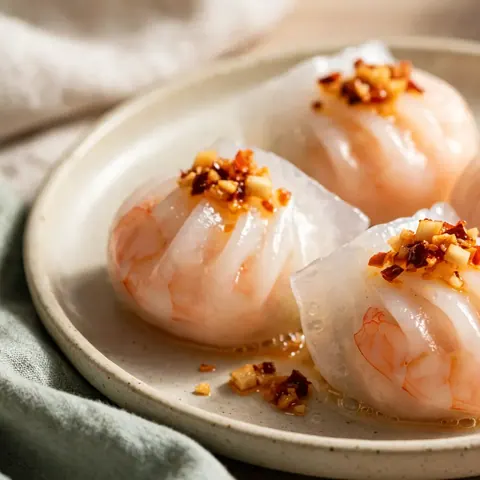
Translucent crystal shrimp dumplings piled with snappy whole shrimp and bamboo shoots, steamed until glassy and finished with a spoonful of sizzling garlic chili crisp.
Published Updated 13 min read
- Total time
- Prep
- Cook
- Serves
- 4
- Makes 12 dumplings
- Cuisine
- Cantonese
- Calories
- 250
- per serving, estimated

On this page16 sections
Har gow are the dumplings everyone reaches for first on a dim sum cart, and this version earns that reach at home. A glassy wheat-starch skin wraps whole, snappy shrimp and crunchy bamboo shoots, and a spoonful of sizzling garlic chili crisp lands on top straight from the pan. The crackle, the snap, the pearl-pink glow through the skin — all of it happens in about an hour.
Har gow look like the hardest thing on the dim sum menu, and they are one of the most honest. The filling is chopped shrimp and bamboo shoots. The dough is two starches and boiling water, kneaded warm and rolled thin. What makes them special is texture: a skin so thin it turns transparent when it steams, and a filling built from whole pieces of shrimp so each bite snaps instead of mushes. The final move here is the garlic chili crisp — oil heated to 350°F (175°C) and poured over raw garlic and chili, which blooms them into something loud, nutty, and just spicy enough. Spooned over the hot dumplings while it still sizzles, it turns a classic into the kind of plate people record before they eat.
The appeal
Why you’ll love it
The crystal dough works because of heat, not technique. Wheat starch contains no gluten-forming proteins, so it never toughens; poured-over boiling water gelatinizes the starch instantly, creating a dough that is smooth, stretchy, and nearly transparent once steamed. The small amount of tapioca starch adds flex, so the thin wrappers resist tearing when pleated and stay tender rather than brittle after steaming. Kneading while the dough is warm keeps it pliable, and a ten-minute covered rest lets every starch granule finish hydrating, which is why the skins roll out without cracks.
The filling and the topping follow the same principle: build texture deliberately. Chopping only part of the shrimp into paste and leaving the rest in chunks means the paste binds the filling while the chunks deliver the snap. Minced bamboo shoots, squeezed dry, add crunch without watering the filling down — moisture is the enemy of a sealed dumpling. The chili crisp is poured, not simmered: oil at 350°F (175°C) hits the garlic and chili hard enough to toast them in seconds, keeping the garlic golden and crunchy rather than bitter and burnt.
What you need
Ingredients
Makes 12 dumplings.
Filling
Dough
Garlic chili crisp
Contains:
- Crustaceans
- Gluten
Tools
Equipment
- Bamboo steamer
- Wok or wide pot with a lid
- Bamboo spatula or dough scraper
- Small saucepan
- Box grater or sharp knife
- Heatproof bowl
- Instant-read thermometer
Swaps
Substitutions
Instead ofWheat starch
UseWheat starch is what makes the skin translucent and there is no true stand-in, but a mix of 2/3 cup cornstarch and 2/3 cup tapioca starch gives a softer, slightly cloudy dumpling.
Instead ofBamboo shoots
UseFinely diced water chestnuts bring the same crunch with a sweeter flavor; squeeze them dry the same way.
Instead ofCrushed red pepper flakes
UseUse 2 tbsp of your favorite coarsely ground dried chili, such as gochugaru, for a fruitier, less searing heat.
Instead ofTapioca starch
UsePotato starch works in the same amount and keeps the skin pliable.
Good to know
Notes
Wheat starch, sometimes sold as wheaten starch, sits near the tapioca flour and rice flour in well-stocked grocery stores and in any Asian market; it is the one ingredient worth hunting for, since it alone gives the translucent skin. Tapioca starch is often labeled tapioca flour — they are the same thing. Buy the largest shrimp you can find, since large pieces are the whole point of the snap; peeled and deveined saves twenty minutes of work.
A bamboo steamer over a wok of water is the classic setup, but any metal steamer basket with a lid works, as long as the dumplings sit on parchment squares so they never weld to the metal. For the chili crisp, use a neutral oil with a high smoke point — canola, vegetable, or avocado oil — since it must reach 350°F (175°C). If the dough cracks while rolling, it has dried out: knead in a few drops of warm water and keep the remaining balls covered at all times.
Prep
Before you start
Set up everything before the dough hits the water, because wheat-starch dough punishes delay. Fill the kettle or a saucepan and have the 3/4 cup of boiling water measured and truly boiling. Line the steamer tray with parchment squares cut about three inches wide, and set the wok or pot with its water already heating. Pat the shrimp dry and chop the filling first, so it can chill while the dough rests.
Step by step
Method
Phase 1
Filling and crystal dough
Step 1: Chop the shrimp filling
Pat the shrimp completely dry, then chop a third of them to a paste with the flat of a knife. Cut the remaining shrimp into three or four chunky pieces each so every bite keeps something to snap into. Fold the paste and the chunks together with the bamboo shoots.
You’ll need: large shrimp · minced bamboo shoots
Look for: The mix should look marbled — sticky paste holding visible, glossy chunks of shrimp.
Tip: Keep the shrimp cold while chopping; firm flesh cuts into clean chunks instead of smearing.
Step 2: Test the filling
Pinch off a small spoonful of the filling, microwave it for twenty seconds, and taste. Adjust the seasoning now, before the dough is made, because the filling is what carries the flavor of the whole dumpling. Rewrap the rest and keep it chilled while the dough comes together.
You’ll need: large shrimp
Look for: The cooked test pinch should taste seasoned but clean, with sweetness up front.
Tip: This two-minute check saves an entire batch from flat-tasting dumplings.
Step 3: Make the crystal dough
Whisk the wheat starch and tapioca starch together in a heatproof bowl. Pour in the boiling water all at once and stir with the bamboo spatula until shaggy clumps form. Add the neutral oil and knead, right in the warm bowl, for two to three minutes until the dough is smooth, glossy, and slightly springy.
You’ll need: wheat starch · tapioca starch · boiling water · neutral oil
Look for: The dough should feel like warm play dough — soft, pliable, with no dry crumbs.
Tip: The water must be fully boiling; cooler water leaves the dough gray and crumbly.
Step 4: Rest and portion the dough
Shape the dough into a log, cover it tightly, and let it sit for ten minutes so the starches fully hydrate. Cut the log into twelve even pieces and roll each into a ball. Keep the balls under a damp towel — exposed wheat-starch dough dries out and cracks within minutes.
You’ll need: wheat starch · tapioca starch
Look for: Cut pieces should be uniform, about the size of a walnut, and stay moist on top.
Tip: A covered dough ball rests while you set up the steamer, so nothing stalls.
Checkpoint
At the end of this phase, the filling is mixed, taste-tested, and chilling, and a smooth dough log has rested and been cut into twelve equal balls under a damp towel. The filling should look marbled — sticky paste with visible glossy chunks of shrimp and pale flecks of bamboo shoot — and it should taste seasoned but clean when the test pinch is cooked. The dough should feel like warm play dough: soft, glossy, and springy, with no dry crumbs at the bowl's edge.
Phase 2
Roll, pleat, and steam
Step 5: Roll the wrappers
Flatten one ball between two sheets of parchment and press or roll it into a four-inch round with slightly thinner edges. Work one wrapper at a time and keep the rest covered. The rounds should look smooth and translucent at the rim before any filling goes in.
You’ll need: wheat starch
Look for: Hold a wrapper up to the light — you should just barely see your fingers through the edge.
Tip: A flat-bottomed bowl or a small plate presses perfectly even wrappers without a rolling pin.
Step 6: Fill and pleat the dumplings
Set a rounded tablespoon of filling in the center of each wrapper. Fold one side over and pleat the edge with your thumb, sealing seven to nine pleats toward the closed side, then press to close. Stand each dumpling pleat-up on a parchment square inside the steamer, leaving a finger of space between them.
You’ll need: large shrimp · wheat starch
Look for: Pleats should sit tight and even, with no filling peeking out of the seam.
Tip: Use the bamboo spatula to tuck filling in; wet fingers stick to the starch dough.
Step 7: Steam until the shrimp glow
Bring the water under the steamer to a full rolling boil so plenty of steam rises, then cover and steam for five to six minutes. The dumplings are done when the skins turn glassy and the shrimp inside glow pearlescent pink and the centers register 145°F (63°C) on an instant-read thermometer.
You’ll need: large shrimp
Internal temperature 145°F (63°C)
Look for: Skins turn from chalky white to fully translucent and dome slightly over the filling.
Tip: Steam in two batches rather than crowding; touching dumplings tear as they puff.
Checkpoint
This phase ends with twelve dumplings standing pleat-up in the steamer, freshly cooked. The skins should be fully translucent — hold one dumpling up and the pink shrimp should glow through clearly — with tight, even pleats and no filling leaking at the seams. A dumpling lifted from the parchment should feel tender and bouncy, not sticky or gummy. Verify the internal temperature of a center dumpling reads 145°F (63°C) with an instant-read thermometer; if not, steam another minute.
Phase 3
Sizzling garlic chili crisp
Step 8: Bloom the garlic and chili
While the dumplings steam, pile the minced garlic and the crushed red pepper flakes into a small heatproof bowl. Stir them together so the chili coats every piece of garlic and the bowl is ready to receive the oil the moment it reaches temperature.
You’ll need: garlic cloves · crushed red pepper flakes
Look for: The minced garlic should sit in a loose, even mound with chili distributed throughout.
Tip: Keep the garlic in a wide bowl so the hot oil hits it all at once and blooms evenly.
Step 9: Pour the sizzling oil
Heat the neutral oil in a small saucepan until it reaches 350°F (175°C) and shimmers. Pour it over the garlic and chili in one steady stream — it should crackle loudly and foam up around the garlic. Stir once and let the sizzle settle into a deep, nutty aroma.
You’ll need: neutral oil · garlic cloves · crushed red pepper flakes
Look for: A loud crackle on contact, then a gentle bubbling that fades within a minute.
Tip: Pour from a low height so the oil foams in the bowl, not over the counter.
Step 10: Dress and serve hot
Transfer the steamed dumplings to a warm plate while the garlic chili crisp is still audibly hot. Spoon the crisp over the pleated tops, letting the sizzling garlic and chili pool around each dumpling. Serve immediately, while the skins are glossy and the garlic still crackles on the bite.
You’ll need: large shrimp · garlic cloves · crushed red pepper flakes · neutral oil
Look for: Skins glisten, pleats stay distinct, and the crisp slides slowly down the sides.
Tip: Spoon the solids onto each dumpling first, then drizzle a little of the infused oil.
Checkpoint
The finish is all about sound and timing. The oil, heated to 350°F (175°C), should crackle loudly the instant it hits the garlic and chili, then settle into gentle bubbling that fades within a minute, leaving the garlic golden and floating in deep-red oil. The aroma is nutty, toasty, and just pungent enough to make the room notice. The dumplings should still be hot enough that the crisp slides slowly down their pleated sides and keeps faintly sizzling on contact.
Doneness
How to tell it’s done
Har gow tell you they are ready in three ways. First, the skins: chalky white dough turns fully glassy and slightly domed when the starch has cooked through. Second, the filling: the shrimp chunks glow pearlescent pink and press back when nudged, rather than looking translucent and loose. Third, and most reliably, temperature: the center of a dumpling should read 145°F (63°C) on an instant-read thermometer, the safe internal temperature for shrimp. If the skins are glassy but the reading is low, steam one more minute and check again.
Avoid these
Common mistakes
The four failures are all preventable. Water that is not fully boiling leaves the dough gray and crumbly — dump it and start again rather than fighting it. Wrappers rolled too thick steam into a pasty, opaque skin; aim for a four-inch round with thin edges and a slightly thicker center. Filling added too generously bursts through the pleats as the shrimp swells; a rounded tablespoon is exactly enough. And dumplings touching in the steamer tear as they puff, so give each one space and steam in two batches if needed.
Cook safely
Food safety
Safe internal temperatures
Cook to at least these temperatures, measured with an instant-read thermometer in the thickest part.
| Food | Minimum internal temperature |
|---|---|
| Shellfish | 145°F (63°C) |
Better results
Tips
Tip 1
Chop the shrimp in two stages and keep it cold between them — cold shrimp cuts into clean, snappy chunks instead of smearing into paste. If the filling feels wet after the bamboo shoots go in, it will fight the pleats; squeeze the shoots hard, and pat the shrimp dry twice. When pleating, use the bamboo spatula rather than fingers to tuck filling: the starch dough sticks to damp hands and tears.
Tip 2
The chili crisp rewards precision twice over. Heat the oil to a full 350°F (175°C) — below that, the garlic steams instead of crisps — and pour in one steady stream from a low height so it foams in the bowl. Make the crisp while the dumplings steam so both finish together; the topping is meant to land on the plate audibly hot. If the garlic browns too fast on a second batch, drop the oil ten degrees and pour more slowly.
Make it yours
Variations
Classic plain har gow
Skip the chili crisp entirely and serve the dumplings with a small dish of the crisp on the side, or simply with a splash of the infused oil. The shrimp and bamboo shoots carry the flavor on their own, exactly as the classic cart version does.
Pork and shrimp dumplings
Replace a third of the shrimp with an equal weight of finely minced fatty pork, mixed in raw with the paste. Steam as directed and confirm the center still reaches 145°F (63°C); the pork adds richness and a deeper, sweeter filling.
Extra-crispy garlic topping
Double the garlic to twelve cloves and add a teaspoon of sesame seeds to the bowl before pouring the oil. The larger volume of solids turns crunchier still and stretches the crisp across a double batch of dumplings.
Ginger shrimp har gow
Grate a teaspoon of fresh ginger into the shrimp filling along with the salt. The ginger warms the sweetness of the shrimp and stands up well to the chili crisp, giving the dumplings a gently spiced backbone.
On the table
Serving suggestions
Serve har gow the way a dim sum parlor does: hot, in a single layer, with nothing between the steamer and the table. Spoon the garlic chili crisp over the pleated tops just before serving, letting some pool on the plate so each dumpling can be dragged through it. A small dish of the crisp on the side lets guests add more as they go.
These work as a starter for four or a full meal for two alongside a simple broth or a plate of greens. If serving a larger group, steam in batches and hold the first batch loosely covered with a clean towel — never in the steamer, where trapped steam toughens the skins. Warm the serving plates, since a cold plate pulls the heat out of the skins and dulls the snap of the shrimp.
Leftovers
Storage & make-ahead
- Fridge
- Refrigerate cooled dumplings up to 2 days and the chili crisp up to 1 week in a sealed jar.
- Freezer
- Freeze assembled raw dumplings on parchment squares for up to 1 month; steam straight from frozen, adding 2 minutes.
- Reheat
- Resteam refrigerated dumplings for 2 minutes, or microwave covered with a damp paper towel for 30 seconds.
Har gow are at their peak within ten minutes of steaming, and the skins begin to stiffen as they cool. Leftovers keep surprisingly well, though: cool the dumplings for no more than 2 hours, then refrigerate them uncovered on a plate so the skins dry slightly and do not stick. The garlic chili crisp keeps separately in a sealed jar, where the garlic stays crunchy for days and only improves.
Make ahead
Both components can be prepared ahead, which makes this a realistic party dish. The filling can be mixed, taste-tested, and refrigerated up to a day in advance, tightly covered. The dough can be made, wrapped well in plastic, and refrigerated overnight; knead it warm in the microwave for twenty seconds before portioning, or it will crack. Fully assembled raw dumplings can be frozen on their parchment squares, then steamed straight from frozen with two extra minutes. The chili crisp itself keeps for a week and can be reheated briefly before serving.
Questions
Frequently asked questions
Why did the dumpling skins turn out opaque instead of translucent?
Translucency depends entirely on wheat starch and boiling water. If a substitute starch was used, or the water was merely hot rather than at a full boil, the starch granules do not fully gelatinize and the skins stay chalky. Wrappers rolled thicker than an eighth of an inch also stay cloudy even when cooked through. Use genuine wheat starch, water at a rolling boil, and thin-edged wrappers.
Can the dumplings be assembled ahead and steamed later?
Yes. Assembled raw dumplings keep on their parchment squares in the refrigerator for a few hours, or freeze solid on a tray and then bag them. Steam refrigerated dumplings as written, and frozen ones straight from the freezer with about two extra minutes. Do not thaw frozen dumplings first, or the skins tear as they soften.
How do the shrimp cook through safely in five minutes?
The filling is chopped fine and spread thin inside a thin wrapper, so steaming at a full boil cooks it quickly and evenly. Verify doneness by temperature rather than time: the center of a dumpling should read 145°F (63°C), the safe internal temperature for shrimp. If the reading is lower, steam another minute and check again; the skins will not overcook in that window.
What makes the garlic crisp instead of burning?
Two things: oil temperature and pour speed. Oil heated to 350°F (175°C) toasts the minced garlic in seconds on contact, crisping it before it can brown, and pouring in one steady stream exposes it evenly. Oil below about 325°F (165°C) fries the garlic slowly into something golden-soft and eventually bitter. An instant-read or candy thermometer removes all guesswork.
Is wheat starch the same as all-purpose flour?
No, and the difference is the whole recipe. Wheat starch is refined to remove the gluten-forming proteins, so it gelatinizes into a pliable, translucent dough instead of an elastic one. All-purpose flour makes a tough, opaque, bready wrapper that cannot be rolled paper-thin. Look for wheat starch near the rice and tapioca flours in Asian markets; tapioca flour is the same product as tapioca starch.
Everything in one place: the recipe card below gathers the ingredients, steps and estimated nutrition, ready to print.
Recipe card
Har Gow with Sizzling Garlic Chili Crisp
Translucent crystal shrimp dumplings piled with snappy whole shrimp and bamboo shoots, steamed until glassy and finished with a spoonful of sizzling garlic chili crisp.
- Prep
- Cook
- Total
- Servings
- 12 dumplings
Ingredients
Filling
- 9 oz large shrimp, peeled, deveined, and patted dry
- 1/3 cup minced bamboo shoots, rinsed and squeezed dry
Dough
- 1 cup wheat starch
- 1/3 cup tapioca starch
- 3/4 cup boiling water
- 2 tsp neutral oil
Garlic chili crisp
- 6 garlic cloves, finely minced
- 2 tbsp crushed red pepper flakes
- 1/3 cup neutral oil, heated to 350°F (175°C)
Instructions
Chop the shrimp filling. Pat the shrimp completely dry, then chop a third of them to a paste with the flat of a knife. Cut the remaining shrimp into three or four chunky pieces each so every bite keeps something to snap into. Fold the paste and the chunks together with the bamboo shoots.
Test the filling. Pinch off a small spoonful of the filling, microwave it for twenty seconds, and taste. Adjust the seasoning now, before the dough is made, because the filling is what carries the flavor of the whole dumpling. Rewrap the rest and keep it chilled while the dough comes together.
Make the crystal dough. Whisk the wheat starch and tapioca starch together in a heatproof bowl. Pour in the boiling water all at once and stir with the bamboo spatula until shaggy clumps form. Add the neutral oil and knead, right in the warm bowl, for two to three minutes until the dough is smooth, glossy, and slightly springy.
Rest and portion the dough. Shape the dough into a log, cover it tightly, and let it sit for ten minutes so the starches fully hydrate. Cut the log into twelve even pieces and roll each into a ball. Keep the balls under a damp towel — exposed wheat-starch dough dries out and cracks within minutes.
Roll the wrappers. Flatten one ball between two sheets of parchment and press or roll it into a four-inch round with slightly thinner edges. Work one wrapper at a time and keep the rest covered. The rounds should look smooth and translucent at the rim before any filling goes in.
Fill and pleat the dumplings. Set a rounded tablespoon of filling in the center of each wrapper. Fold one side over and pleat the edge with your thumb, sealing seven to nine pleats toward the closed side, then press to close. Stand each dumpling pleat-up on a parchment square inside the steamer, leaving a finger of space between them.
Steam until the shrimp glow. Bring the water under the steamer to a full rolling boil so plenty of steam rises, then cover and steam for five to six minutes. The dumplings are done when the skins turn glassy and the shrimp inside glow pearlescent pink and the centers register 145°F (63°C) on an instant-read thermometer.
Bloom the garlic and chili. While the dumplings steam, pile the minced garlic and the crushed red pepper flakes into a small heatproof bowl. Stir them together so the chili coats every piece of garlic and the bowl is ready to receive the oil the moment it reaches temperature.
Pour the sizzling oil. Heat the neutral oil in a small saucepan until it reaches 350°F (175°C) and shimmers. Pour it over the garlic and chili in one steady stream — it should crackle loudly and foam up around the garlic. Stir once and let the sizzle settle into a deep, nutty aroma.
Dress and serve hot. Transfer the steamed dumplings to a warm plate while the garlic chili crisp is still audibly hot. Spoon the crisp over the pleated tops, letting the sizzling garlic and chili pool around each dumpling. Serve immediately, while the skins are glossy and the garlic still crackles on the bite.
Allergens: Crustaceans, Gluten
Nutrition (estimated, per serving)
- Calories
- 250 kcal
- Protein
- 18 g
- Carbs
- 28 g
- Fat
- 8 g
- Sodium
- 420 mg
Estimates only: values vary with brands, substitutions and portion sizes.
Recipe by EasyCooks Kitchen · easycooksrecipes.com
Share this recipe
Send it to someone who’d love it, or save it for later.
Spotted a mistake in this recipe? Let us know.
Keep cooking


